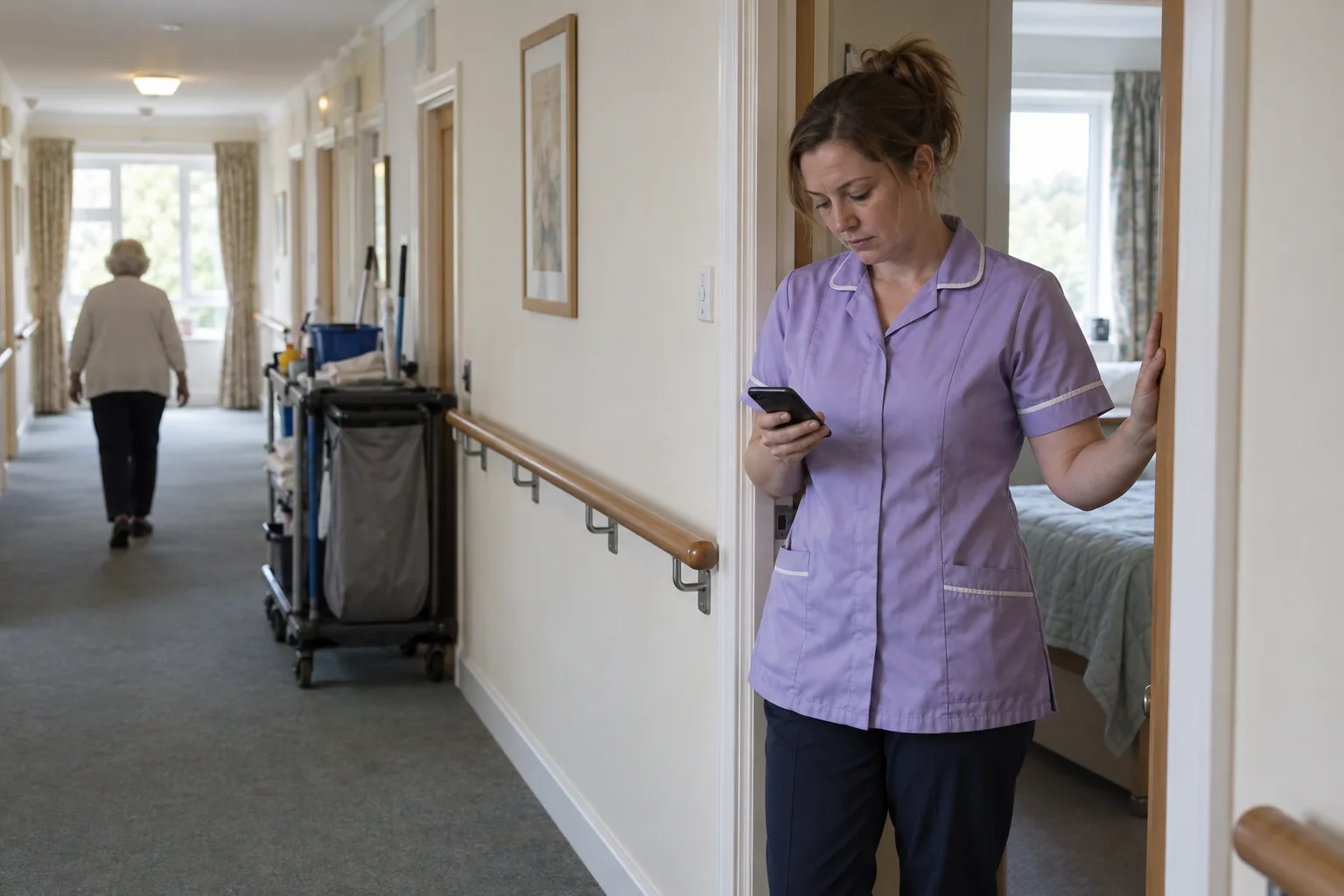

The question is usually asked the wrong way round. WhatsApp is not compliant or non-compliant in itself – UK GDPR places duties on the organisation using it, and the honest question is whether you can meet yours while your work conversations live there. This is a plain summary of what changes with the Business Platform, what does not, and where the risk actually sits.
Is WhatsApp GDPR compliant?
No messaging app is GDPR compliant on its own, and any vendor claiming their product makes you compliant is overselling. The General Data Protection Regulation, as retained in UK law, places obligations on the controller – the organisation deciding why and how personal data is processed. That is you, not the app.
So the real question is whether you can discharge those obligations while business communication happens on WhatsApp. For most organisations the answer is a qualified no on the consumer app, and a heavily qualified maybe on the WhatsApp Business Platform, for reasons that have nothing to do with encryption.
WhatsApp's end-to-end encryption is genuinely strong and it is the thing people reach for when defending its use. It protects messages in transit. It says nothing about whether you can find, retain, delete or produce the personal data inside them, and those are the duties that actually get tested.
It is also worth separating data security from data privacy. Encryption is a security control. GDPR compliance is mostly about the other things: lawful basis, purpose limitation, retention, access and accountability. An organisation can have excellent data security and still be violating GDPR comprehensively, and business use of a consumer messaging app is the standard example.
What Meta receives, and why metadata matters
Message content on WhatsApp is end-to-end encrypted, so Meta cannot read it. Metadata is a different matter, and it is the part that reaches your data protection regulations analysis.
Meta processes who messaged whom, when, how often, from which device, and the phone numbers involved. In a work context those phone numbers are personal data of your staff and often of your customers or service users, and the pattern of communication can itself be revealing – who contacted a safeguarding lead, and when.
If you adopt the WhatsApp Business Platform then customer data flows through Meta's infrastructure under its business terms, and you will need to account for that in your record of processing, your privacy notice and, where relevant, your transfer assessments. Consumer WhatsApp gives you no basis to account for any of it, because you are not party to the arrangement at all: your staff are, personally.
Three different things called WhatsApp
Most confused discussions come from conflating these, so it is worth separating them.
- Consumer WhatsApp. A personal account on a personal device. The organisation has no administrative control, no export, no retention control and no visibility. Whatever policy you write, this is what your staff are actually using.
- The WhatsApp Business app. A free app aimed at sole traders and small businesses. Slightly more structure – catalogues, quick replies, labels – but still a personal handset with no central administration and no organisational record.
- The WhatsApp Business Platform, commonly called the API. A commercial product accessed directly from Meta or through a business solution provider, where messages can flow into a system the organisation controls. This is what larger organisations mean when they say they use WhatsApp compliantly.
Only the third gives you anything resembling a record, and it brings its own constraints: it is built for customer messaging rather than internal conversation, it charges per message, and it operates on a 24-hour session window outside which you may send only pre-approved template messages. It does not solve staff talking to each other.
The duties that are hard to meet
Five obligations cause the difficulty, and they are the same five whichever WhatsApp you mean.
- Right of access. A subject access request covers work-related messages wherever held, including personal devices. One month to respond, and no way to search. Covered in detail in our guide on SARs and WhatsApp messages.
- Storage limitation. Personal data must not be kept longer than necessary. A group chat has no retention period and no deletion mechanism, so your data retention policy simply does not reach it.
- Accountability. You must be able to demonstrate compliance. Processing you cannot see cannot be demonstrated, and it will not appear in your record of processing activities either.
- Breach notification. A lost phone or a message sent to the wrong group may be a personal data breach requiring assessment and possibly an ICO report within 72 hours. You will struggle to establish what was in scope.
- Security and access control. A leaver keeps every message on their device. There is no revocation, and no way to know what they still hold.
Notice that none of these is fixed by encryption, and none is fixed by a policy on its own.
Can an employer make staff use WhatsApp for work?
Realistically, no, and it is a weaker position than employers expect.
Requiring an employee to use their personal WhatsApp account for work means requiring them to use a personal contract with a third party, on a device they own and pay for, and to disclose their personal mobile number to colleagues or customers. Each of those is something an employee can reasonably decline.
If you want messaging to be part of the job, the organisation has to provide the means – the device, or an account, or a channel that is the organisation's rather than the individual's. An instruction to use a personal account is likely to be an unreasonable one, and enforcing it through a disciplinary process would be an uncomfortable case to argue.
The same reasoning cuts the other way and employers often miss it: because the account is personal, you also cannot audit it, cannot compel access to it, and cannot delete from it.

Personal devices: what a bring-your-own-device policy has to settle
Whether or not WhatsApp is involved, staff using personal mobile phones for work, whether in the office or working remotely, is a data protection question in its own right, and the answer is a policy, not a prohibition. The security risks are the ordinary ones, unauthorised access to a lost or shared mobile device, work data backed up to personal cloud storage, and confidentiality lost when a family member picks up the phone, and they are the same whether the app is WhatsApp or the organisation's own. The National Cyber Security Centre's bring-your-own-device guidance says BYOD "requires careful design" because it balances an organisation's "need to protect and maintain control of its data and systems against the usability, and privacy expectations of the device owner", and warns that a badly designed scheme drives people to shadow IT, which in most organisations means a personal messaging group.
The NCSC's policy questions are the right list for an employer of any size:
- What tasks are permitted. "What tasks will employees be permitted or encouraged to do from their own devices? What will they not be permitted to do?" Reading a rota is different from handling a safeguarding concern, and the NCSC is explicit that "users with privileged or administrative access should not have this level of access from a personal device".
- What data is exposed. "What services will you expose to personal devices? What data you will expose from within those services?" The line most organisations can hold is the one in section 08: logistics on personal devices, named people on the organisation's.
- What happens on change and departure. "How will you handle an employee changing their device, changing their role, or leaving the organisation? What method will you use to remove access and corporate data (if stored on the device)?" For a personal WhatsApp account the honest answer is that you cannot, which is the whole argument for not putting the data there.
- What happens in an incident. "What will you do in the event of a security incident? How will you deal with potential loss, theft or compromise of devices and data?" A lost phone with a work group on it is a personal data breach to assess, and possibly to report, under UK GDPR.
- How much control you are asking for. "How much control will your employees be willing to grant you over their devices, and how much control do you need?" The NCSC notes that employees "may not like the idea of their employer being able to remotely wipe their entire device". Most small organisations should design so that they never need to.
Data protection adds three duties that a BYOD policy should state plainly. Personal data on a personal device is still the organisation's responsibility as controller, so the storage limitation principle applies to messages on it. Monitoring a worker's personal device is a separate and heavily constrained activity under the ICO's employment practices guidance on monitoring workers, and a policy that implies the employer may inspect a personal phone promises something it cannot lawfully deliver as a matter of routine. And the policy must be honest about the personal number: a group that exposes it is sharing personal data, which is a reason to ask, not to instruct.
The practical shape for a small organisation is a one-page bring your own device policy that says which apps and tasks are approved when using personal devices, that sensitive data and restricted information stay on organisation-controlled channels, that any mobile device carrying work data has a strong password or biometric lock and is not backed up to personal cloud storage, that access is removed on leaving by removing the account rather than by asking for the phone, that a lost or stolen device is reported the same day so the risk of data breaches can be assessed, and that the organisation does not monitor personal devices. Written that way, it is a policy people can keep, and it does more to protect personal data than a ban.
Can private WhatsApp messages be used in disciplinary action?
Yes, where the conduct affects the employment relationship. Messages in a work-adjacent group have been relied on in disciplinary processes and in employment tribunals, and "it was a private group" has not proved a reliable defence. How such messages should be gathered, shared and weighed at a hearing is covered in our guide to WhatsApp messages in a disciplinary hearing.
There is a genuine tension here that a policy should acknowledge rather than gloss. Employees have a reasonable expectation of privacy in personal communications, and monitoring them engages both UK GDPR and the Human Rights Act. An employer who goes looking through personal messages without a lawful basis and a proportionate reason creates a second liability while investigating the first.
The practical rule: you may use messages that come to you legitimately, such as one a recipient reports. Going hunting on a personal device is a different act and needs advice.
Reducing the risk, honestly
If work conversations are happening on WhatsApp today, four things help and one does not.
- Write down which channel carries what, and give people somewhere to go rather than only something to stop.
- Draw the line at people. Logistics in a group chat is a small risk. Named service users, pupils, patients or employees is a large one. Most organisations can hold that line even when they cannot hold a total ban.
- Update your record of processing and your privacy notice to reflect what is actually happening, not what the policy says should be.
- Provide an alternative that is genuinely as fast. This is the only intervention that reliably changes behaviour, and it is the one usually skipped.
Two best practices are worth adding if WhatsApp use is going to continue. Get explicit consent before adding anyone external to a group, since doing so shares their phone numbers with everyone in it. And review data sharing at offboarding: a leaver's device is the commonest route by which WhatsApp communications outlive the relationship that justified them.
What does not help is a written ban with no alternative. The group re-forms under a different name, and now it is also concealed – which is worse for you than the original, because your policy asserts something your organisation cannot evidence.
It is also worth being clear, including about products like ours: no lawful product can read a personal WhatsApp account or retrieve conversations that have already happened. Anything sold on that basis is describing something that does not work. Historic exposure on personal devices is closed by policy and time, not by software.
Questions people ask
What are the GDPR changes in 2026?
In 2026 most of the Data (Use and Access) Act 2025's changes to UK data protection law took effect: the government's plans for commencement brought the majority of its data protection provisions into force on 5 February 2026, and the ICO's page on the Act says all of them are now in force. For employers the practical changes include helping people make data protection complaints and acknowledging them within 30 days, reasonable and proportionate searches for subject access, and a new lawful basis of recognised legitimate interests.
Can my personal data be shared without permission?
Yes, if the organisation has another lawful basis: consent is only one of the lawful bases in Article 6 of UK GDPR, alongside contract, legal obligation, vital interests, public task, legitimate interests and recognised legitimate interests. Whatever the basis, the sharing must still meet the principles in Article 5, including fairness, transparency and data minimisation, so adding a colleague's personal number to a work group still needs a lawful basis and a reason.
Can you explain the GDPR in a simple way?
UK GDPR is the law on how organisations use information about people. It sets seven principles in Article 5 – lawfulness, fairness and transparency; purpose limitation; data minimisation; accuracy; storage limitation; integrity and confidentiality; and accountability – and gives people rights, such as the right of access to their own data in Article 15. The organisation deciding why and how the data is used, the controller, "shall be responsible for, and be able to demonstrate compliance with" those principles.
Where to read the official guidance
The ICO's guidance for organisations covers the controller duties, and its guidance on monitoring workers is the one to read before investigating anybody's messages. WhatsApp publishes its own business terms and data processing terms for the Business Platform, which your DPO will want if you go that route.
This page is a summary, not legal advice. A live disciplinary matter or a monitoring decision is one to take advice on.
ComplyChat gives work conversations a channel your organisation owns, on the record from the first message and, on paid plans, meeting your retention schedules within your own Microsoft 365 subscription once your tenant is connected – so retention, access and production are yours. There is no WhatsApp, no WhatsApp Business Platform and nothing from Meta anywhere in the path, and as section 08 says, we cannot see a personal phone.
How it works · Why us · Pricing · FAQ
Sources
Every document this guide quotes or links to, in the order it first cites them.
- Bring-your-own-device guidance ncsc.gov.uk
- Policy questions ncsc.gov.uk
- Storage limitation principle ico.org.uk
- Employment practices guidance on monitoring workers ico.org.uk
- Plans for commencement gov.uk
- The ICO's page on the Act ico.org.uk
- Article 6 of UK GDPR legislation.gov.uk
- Article 5 legislation.gov.uk
- Article 15 legislation.gov.uk
- Guidance for organisations ico.org.uk