
The definition: what a low-level concern is
The rule is in Part four, section two of Keeping children safe in education 2026, the statutory guidance governing bodies and proprietors must have regard to. Paragraph 509 gives the definition, and its first sentence is the one to put at the top of the policy: “The term ‘low-level’ concern does not mean that it is insignificant.” “A low-level concern is any concern – no matter how small, and even if no more than causing a sense of unease or a ‘nagging doubt’ – that an adult working in or on behalf of the school or college may have acted in a way that: is inconsistent with the staff code of conduct, including inappropriate conduct outside of work, and does not meet the harm threshold or is otherwise not serious enough to consider a referral to the LADO.” The concern may relate to their conduct outside work as much as inside it, and it is about adults working with children in any capacity, not only teachers.
The examples the guidance gives are deliberately ordinary: “being overfriendly with children, having favourites, taking photographs of children on their mobile phone, contrary to school policy, engaging with a child on a one-to-one basis in a secluded area or behind a closed door, or humiliating children.” Paragraph 510 explains why the ordinary matters: such behaviour “can exist on a wide spectrum, from the inadvertent or thoughtless, or behaviour that may look to be inappropriate, but might not be in specific circumstances, through to that which is ultimately intended to enable abuse”. The policy exists because nobody can tell from one incident which end of the spectrum they are looking at, and only a record makes the pattern visible.
Paragraph 508 states the purpose in a sentence a governing body can adopt as its own: “Creating a culture in which all concerns about adults are shared responsibly and with the right person, recorded and dealt with appropriately, is critical.” Done correctly, it should “enable schools and colleges to identify inappropriate, problematic or concerning behaviour early, minimise the risk of abuse, and ensure that adults working in or on behalf of the school or college are clear about professional boundaries and act within these boundaries”. Paragraph 512 adds the protective purpose for staff themselves: sharing concerns responsibly “should also protect those working in or on behalf of schools and colleges from becoming the subject of potential false low-level concerns or misunderstandings”. The policy is as much about clearing up a misunderstanding early as about catching a pattern. The concept was developed by Farrer & Co, whose guide to developing and implementing a low-level concerns policy KCSIE cites at paragraph 528 for “more detailed guidance and case studies”.
What counts, who it covers and where the line with an allegation falls
The definition turns on the staff code of conduct: a low-level concern is behaviour “inconsistent with” it, which is why paragraph 527 says “a good low-level concerns policy will simply be a reflection and extension of the school or college’s wider staff behaviour policy/code of conduct”. A code that is vague produces a low-level concerns policy that cannot be applied. In practice the concerns a school receives fall into recognisable groups:
- Boundaries: favouritism, over-familiarity, gifts, a pupil in a car or a classroom alone with the door shut when the policy says otherwise, contact with a pupil outside the purposes of the work.
- Communication: a personal number or social media account shared with a pupil, a reply from a personal account, a staff member in a pupils’ group chat, remarks about a child in a staff group.
- Images and devices: photographs on a personal phone, images kept after the trip, a phone out during lessons in breach of the school’s own rule.
- Conduct outside work, which paragraph 509 includes in terms: behaviour in the community, online or in another job that is inconsistent with the code.
- Self-referrals: paragraph 519 asks schools to create an environment where staff “feel confident to self-refer” after “a situation which could be misinterpreted, might appear compromising to others, and/or on reflection they believe they have behaved in such a way that they consider falls below the expected professional standards”.
Who it covers is anyone “working in or on behalf of the school or college”: employed staff, supply staff, volunteers, contractors, governors and trustees. Concerns or allegations about any of them go through the same two doors, and the code of conduct for staff should say so. Paragraph 517 adds a step schools miss: concerns about “supply staff and contractors should be notified to their employers, so that any potential patterns of inappropriate behaviour can be identified”, because the agency sees the pattern across schools that no single school can.
The line with an allegation is the harm threshold in Part four, section one, paragraph 437: behaviour that “has harmed a child, or may have harmed a child”, that may be “a criminal offence against or related to a child”, that “indicates he or she may pose a risk of harm to children” or that “indicates they may not be suitable to work with children”. Anything meeting one of those goes to the local authority designated officer (LADO) under section one, and paragraph 518 settles the uncertainty in between: “If schools and colleges are in any doubt as to whether the information which has been shared about a member of staff as a low-level concern in fact meets the harm threshold, they should consult with their LADO.” The policy should say that in those words, so nobody has to decide alone.
The policy: purpose, sharing concerns, and responding to low-level concerns
Paragraph 513 says where the policy lives: “as good practice governing bodies and proprietors should set out their low-level concerns policy within their staff code of conduct and safeguarding and child protection policies”. It should “make it clear what a low-level concern is and the importance of sharing low-level concerns”, and explain its purpose – “to create and embed a culture of openness, trust and transparency in which the school or college’s values and expected behaviour set out in the staff code of conduct are lived … and reinforced constantly by all staff”. Paragraph 515 lists what the policy is for: making staff “clear about what appropriate behaviour is”, “empowering staff to share any low-level safeguarding concerns”, “addressing unprofessional behaviour and supporting the individual to correct it at an early stage”, handling concerns “sensitively and proportionately”, and “helping identify any weakness in the school or college’s safeguarding system”.
The procedure has to name a person. Paragraph 516: the policy should contain “a procedure for sharing confidentially such concerns which is clear, easy to understand and implement”. Whether concerns go first “to the designated safeguarding lead (or a nominated person such as a values champion), or with the headteacher/principal is a matter for the school or college to decide”; if the DSL receives them, the DSL “should inform the headteacher/principal of all the low-level concerns and in a timely fashion”. Then the sentence that fixes accountability: “The headteacher/principal should be the ultimate decision maker in respect of all low-level concerns”, with a collaborative approach permitted where the head wishes to consult the DSL. The policy should also say who receives a concern about the headteacher – usually the chair of governors or the trust – because a procedure with one door does not work when the concern is about the person behind it. And it should say, in plain words, that concerns can be raised about anyone, that the person reporting the concern will be treated fairly whatever the outcome, and that a concern about another member of staff is an act of professional responsibility, not disloyalty; that is what “create a culture” in paragraph 513 means in practice.
Paragraphs 525 and 526 describe the response. Where a concern “has been raised via a third party, the headteacher/principal (or a nominated deputy) should collect as much evidence as possible by speaking: directly to the person who raised the concern, unless it has been raised anonymously, and to the individual involved and any witnesses.” That information “will help them to categorise the type of behaviour and determine what further action may need to be taken”, and – this is the record again – “this information needs to be recorded in writing along with the rationale for their decisions and action taken”. The outcomes are the ordinary ones: a conversation and a note, support or training, a change to the school’s own practice, the disciplinary procedure, or a referral to the LADO if the picture has changed.
The record: what is written, where it is kept, how long, and the review for patterns
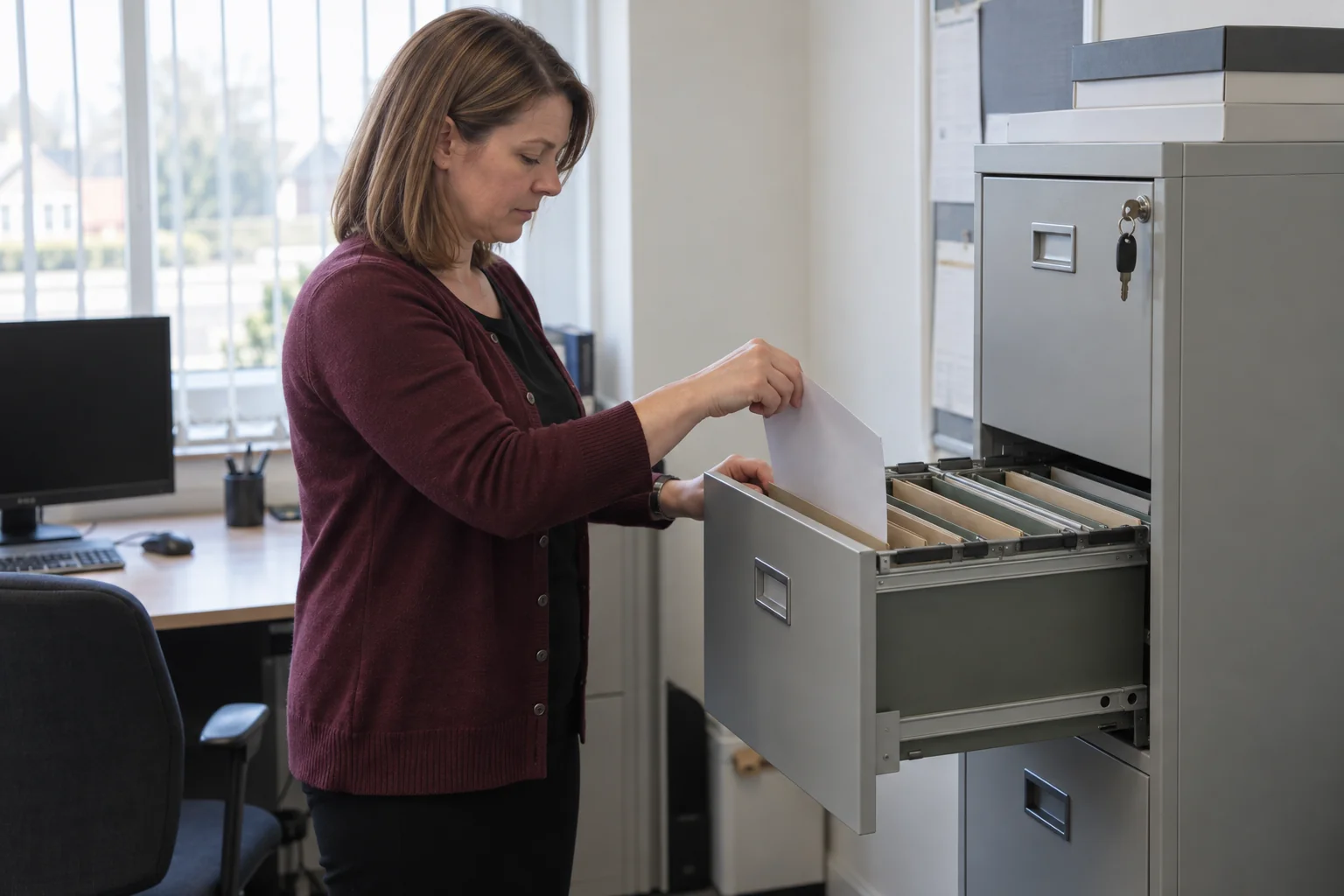
Paragraph 520 is the whole record-keeping rule and it is short: “All low-level concerns should be recorded in writing. The record should include details of the concern, the context in which the concern arose, and action taken. The name of the individual sharing their concerns should also be noted, if the individual wishes to remain anonymous then that should be respected as far as reasonably possible.” Paragraph 526 adds the rationale for the decision. A record that meets both is one entry with these fields:
- Date and time the concern was received, and how (in person, by email, by message, by a third party).
- Who raised it, or that they asked to remain anonymous.
- The adult the concern is about, and their role (employee, supply, volunteer, contractor, governor).
- The concern itself, in the words it was raised in, kept separate from any interpretation.
- The context in which it arose: where, when, who else was present, what the policy said about the situation.
- What was done: who was spoken to, what they said, and the categorisation reached.
- The decision, the rationale for it and the action taken, signed by the headteacher or the nominated deputy.
- The review date and who reviewed the file for a pattern.
Where the record lives is for the school: paragraph 521 says “schools and colleges can decide where these records are kept, but they must be kept confidential, held securely and comply with data protection laws.” One practical arrangement is a restricted low-level concerns file, with clear links to any relevant personnel or child protection record, held by the head or DSL, with access limited to those who need it, and a data protection basis the school can name (it is processing personal data about the adult and, often, about a child). Retention is in paragraph 523: “It is for schools and colleges to decide how long they retain such information, but it is recommended that it is retained at least until the individual leaves their employment.”
Then the paragraph that gives the whole exercise its point. Paragraph 522: “Records should be reviewed so that potential patterns of inappropriate, problematic or concerning behaviour can be identified.” Where a pattern is found, the school “should decide on a course of action, either through its disciplinary procedures or where a pattern of behaviour moves from a low-level concern to meeting the harm threshold, in which case it should be referred to the LADO”. Patterns of behaviour are the point: a single concern rarely says anything about an adult’s suitability to work with children, while three of the same kind over a year may, and the file is the only place the three can meet. And the review looks outward as well: “Consideration should also be given to whether there are wider cultural issues within the school or college that enabled the behaviour to occur and where appropriate policies could be revised, or extra training delivered.” A review that happens is one that is diarised – termly is common – and minuted, so that the school can show it looked.
References, and what a concern may become
Paragraph 524 keeps low-level concerns out of most references, and the rule needs quoting because it is often got wrong in both directions. Part three of KCSIE says schools “should only provide substantiated safeguarding concerns/allegations (including a group of low-level concerns about the same individual) that meet the harm threshold in references. Low-level concerns should not be included in references unless they relate to issues which would normally be included in a reference, for example, misconduct or poor performance. It follows that a low-level concern which relates exclusively to safeguarding (and not to misconduct or poor performance) should not be referred to in a reference.” Apply that distinction carefully: a safeguarding concern belongs in a reference only where it is substantiated and meets the harm threshold. Misconduct and poor performance have their own reference considerations; references must remain fair and accurate.
That is also why the record has to be honest about what each concern became. A concern that was looked into and found to be nothing is recorded as such, with the rationale, and is handled under the applicable retention and accuracy rules; a concern that led to a conversation and a reminder of the policy is recorded with that outcome; a concern that became a disciplinary matter is recorded as one. The safer working practice guidance frames the same point as a principle for staff: “deliberately invented/malicious allegations are extremely rare”, and “all concerns should be reported and recorded”.
The Safer Recruitment Consortium’s Guidance for safer working practice (2022) closes the loop from the staff side. It states that “all concerns that do not meet the harm threshold must be recorded and dealt with appropriately as a low level concern as referenced in Keeping children safe in education”, and its underpinning principles include that staff “should work, and be seen to work, in an open and transparent way including self-reporting if their conduct or behaviour falls short of these guiding principles”. A school that adopts the guidance as part of its code of conduct, as its introduction invites, has most of the behavioural side of the low-level concerns policy already written.
The part most policies leave unwritten: where the concern was first raised
Every paragraph above assumes that a concern arrives, is written down and can be reviewed. Look at how concerns actually arrive. A teaching assistant’s “nagging doubt” about a colleague is a message to a friend on the staff at half past eight in the evening. The friend’s reply – “I noticed that too” – is the second data point in a pattern, and it is on two personal phones. The head of year who is told the next morning texts the DSL because the DSL is in a meeting. The self-referral paragraph 519 hopes for is, when it happens, a WhatsApp: “Just so you know, X found my Instagram and messaged me, I didn’t reply.” The head’s decision, taken in a corridor, is confirmed to the DSL in a text.
People have noticed and shared concerns, but reporting to a colleague is not a substitute for reaching the person named in the policy. But the record paragraph 520 requires begins, in each case, only when someone later types a summary into a form, and the review for patterns that paragraph 522 depends on can only see what reached the file. The two staff who each had a doubt and shared it with each other, never with the DSL, are exactly the pattern the policy exists to catch, and the school has no way to know it happened. Original work messages may also be difficult to retrieve from personal apps if the LADO, a disciplinary panel or a tribunal later asks for them. Any search or retrieval must be proportionate and respect privacy and data protection law.
Use a restricted reporting route, with access limited to the people who need the information. A recorded message is not proof that someone has read or acted on a concern: follow the safeguarding procedure, contact the responsible person directly when action is urgent, and use the local authority or emergency route when required. Add the relevant information and decisions promptly to the formal safeguarding record.
A school cannot move the nagging doubt off the phone; that is where staff think. It can move the sharing of it onto a channel the school runs, where the DSL is in the conversation from the first message, where everyone in the channel has been told it is on the record, and where the concern, the context and the first reply are the record rather than a later summary of it. The question for the governing body is therefore not whether the low-level concerns policy exists, but whether the channel the policy tells staff to use is one they can reach at half past eight in the evening from a personal phone, and one the school can produce from afterwards.
Official guidance and your next step
The primary source is Keeping children safe in education 2026, Part four: section one (paragraphs 437 onwards) for allegations that may meet the harm threshold, and section two (paragraphs 508 to 528) for concerns that do not. Paragraph 123 in Part two requires the staff behaviour policy to include low-level concerns. The Safer Recruitment Consortium’s Guidance for safer working practice (2022) supplies the behavioural standard the concerns are measured against, and Farrer & Co’s guide to developing and implementing a low-level concerns policy, cited by KCSIE at paragraph 528, has the case studies.
This guide is a summary of published guidance for England, not a substitute for it and not legal advice. Colleges should read the college-specific wording; independent schools should read the Independent School Standards alongside KCSIE.
Then do one thing: open the low-level concerns file and count how many entries in the last year record how the concern first arrived. For each one that arrived as a message, ask whether the school could produce that message today.
We build ComplyChat for the work conversations organisations need to keep. The organisational archive described here is available on paid plans, with a connected Microsoft 365 tenant and retention configured by the organisation. A low-level concern is raised in a conversation, and the review for patterns depends on that conversation being somewhere the school can see. ComplyChat is a channel the school owns, on a compatible phone including a personal one, on the record from the first message, with everyone in it told so, filing into the school’s own Microsoft 365 once the tenant is connected and kept under the school’s own retention rules. The DSL can be in the channel from the first message rather than receiving a summary later. It is not a case-management system and it does not replace the low-level concerns file; it is where a concern and the response can be recorded. A member of staff’s own messages stay in their own apps. There is no WhatsApp, Signal or Meta anything in the path.
How it works · Why us · Pricing · FAQ