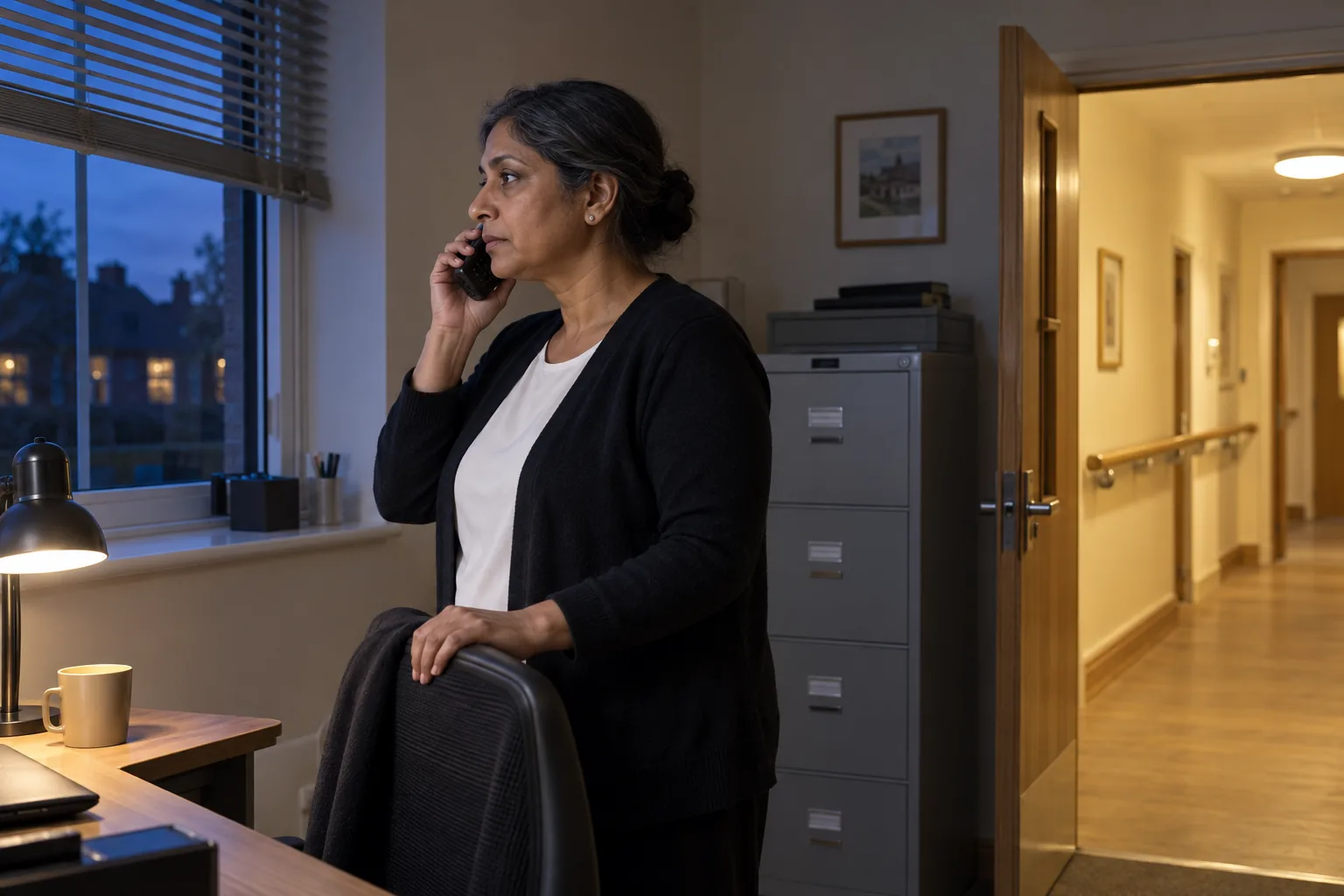

The role, and where it comes from
The Care Quality Commission (CQC) describes the role in one sentence: "A manager is a person who is in day-to-day charge of delivering a service provider's regulated activity, or a service provider's regulated activity in a particular location." The registration framework is the Health and Social Care Act 2008, and the circumstances in which a service must have a registered manager are set by the Care Quality Commission (Registration) Regulations 2009. CQC's scope of registration guidance puts the rule plainly: "Any service provider that is an organisation – whether corporate (for example, a company) or unincorporated (for example, a partnership or a charity) – must have a registered manager for every regulated activity that it carries on, unless it is a health service body." An NHS trust is a health service body; an independent provider working under contract to the NHS is not, and "must always have a registered manager". A sole trader needs one only if they are not themselves "a fit person to manage the regulated activity", or do not intend to be in day-to-day charge of how it is provided. In adult social care that means every care home, homecare agency, supported living and extra care service run by a company, a charity or a partnership.
The role is personal. CQC's page for new managers says: "You share legal responsibility with your provider to meet the requirements of regulations. We will often use you as the key contact for a service." Throughout the regulations the phrase "registered person" means the registered provider and the registered manager together, and most of the duties in the Health and Social Care Act 2008 (Regulated Activities) Regulations 2014 attach to the registered person, not to the organisation alone. A registered manager can be registered for more than one regulated activity, and for more than one location "if they can provide evidence that they are able to do this effectively"; and more than one person can be registered to manage the same location, for example in a job share.
Two other roles are often confused with it. The nominated individual, under Regulation 6, is the person an organisational provider names to supervise the management of the regulated activity and to be CQC's senior contact; a director, an owner or a head of operations, and not the person in day-to-day charge. The care home manager who has not yet been registered is an employee with a job title, and "you cannot manage regulated activities until we confirm your registration". A service whose manager has left and whose replacement is not yet registered is running without one, and its registration usually carries a condition that it must have one.
Regulation 7 of the 2014 Regulations is the fitness test. CQC cannot prosecute for a breach of Regulation 7, "but we can take regulatory action", and "CQC must refuse registration if providers cannot satisfy us that they can and will continue to comply with this regulation". The regulation itself is short enough to quote in full, and the next section takes it limb by limb.
Fit to manage: the four limbs of Regulation 7
Regulation 7(1) says: "A person (M) shall not manage the carrying on of a regulated activity as a registered manager unless M is fit to do so." Regulation 7(2) then says M is not fit "unless M is – (a) of good character, (b) has the necessary qualifications, competence, skills and experience to manage the carrying on of the regulated activity, (c) able by reason of M's health, after reasonable adjustments are made, of doing so, and (d) able to supply to the Commission, or arrange for the availability of, the information relating to themselves specified in Schedule 3." Regulation 7(3) adds that in assessing character "the matters considered must include those listed in Part 2 of Schedule 4". CQC's guidance on Regulation 7 says what it expects under each.
Good character. Schedule 4, Part 2 names two matters: "whether the person has been convicted in the United Kingdom of any offence or been convicted elsewhere of any offence which, if committed in any part of the United Kingdom, would constitute an offence", and "whether the person has been erased, removed or struck-off a register of professionals maintained by a regulator of health care or social work professionals". Part 1 of the same schedule, the unfit person test, adds undischarged bankruptcy, bankruptcy restrictions, a debt relief order moratorium, an undischarged composition with creditors, inclusion in the children's or adults' barred list, and any statutory prohibition from the role. CQC's guidance says providers "must follow robust processes to make sure that they gather all available information" and that it expects those processes to "take account of honesty, trustworthiness, reliability and respectfulness". Two sentences in that guidance are the ones providers miss. If information emerges after appointment that suggests a manager is not of good character, the provider "must take appropriate and timely action to investigate and rectify the matter"; and where a provider considers a manager suitable despite such information, "the provider's reasons should be recorded for future reference". A conviction is not automatically disqualifying; an unrecorded decision about one is a finding waiting to be made.
Qualifications, competence, skills and experience. CQC expects the manager to "demonstrate that they have appropriate knowledge of applicable legislation including the Health and Social Care Act 2008 (Regulated Activities) Regulations 2014 (Part 3), relevant best practice and guidance and understand the consequences of failing to take action on set requirements". There is no single mandatory qualification in the regulation. CQC's new-manager guidance says that for a homecare service "a Level 5 Diploma in Leadership and Management or an equivalent qualification would strengthen your application", that applicants "must have proven management experience and be able to demonstrate this", that recent experience managing a relevant regulated service "is highly desirable", and that for some services the applicant must show they can handle complaints, mental capacity assessments, safeguarding issues and medication errors. The provider's side of this limb is the one with a records duty attached: it "must have appropriate processes for assessing and checking that the individual holds the required qualifications and has the competence, skills and experience required to undertake the role. These processes must be followed in all cases and relevant records kept."
Health, after reasonable adjustments. CQC is explicit that this limb "does not mean that people who have a long-term condition or disability cannot hold such positions". The provider "must have processes for considering the person's physical and mental health in line with the requirements of the role", and all reasonable adjustments must be made, in line with the Equality Act 2010. The evidence CQC asks for at registration is "evidence of health (such as a medical reference)" and the contact details of the applicant's GP.
The Schedule 3 information. Schedule 3 of the 2014 Regulations lists the documents that must be available for any person appointed for the purposes of a regulated activity, and CQC's registration guidance summarises them for a manager: proof of identity; an enhanced Disclosure and Barring Service check with barred list information, which for a manager must be countersigned by CQC and, at application, issued within the past twelve months; a full employment history from the age of sixteen with any gap of more than four weeks explained, and, where the work involved children or vulnerable adults, evidence of conduct and the reason for leaving; records of qualifications; and evidence of health. Applicants are warned that "you could be fined up to £2,500 if you provide false or misleading information".
The registration itself is an application, a review, an interview and a decision by email, and CQC says the assessment "is thorough and can take a few months". The fit person interview tests the second limb in person: the regulations, the fundamental standards, the service's own risks, safeguarding, complaints, the Mental Capacity Act. The provider who has done its own assessment first, and kept the record, has a manager who passes it.
What you are accountable for once registered
Registration turns a job into a legal position. From the date CQC confirms it, the manager is a registered person, and the duties in Part 3 of the 2014 Regulations, the fundamental standards, are the manager's duties as well as the provider's: person-centred care (Regulation 9), dignity and respect (10), consent (11), safe care and treatment (12), safeguarding from abuse and improper treatment (13), nutrition and hydration (14), premises and equipment (15), complaints (16), good governance (17), staffing (18), fit and proper persons employed (19) and the duty of candour (20).
Regulation 22 says which of those failures are crimes. Under Regulation 22(1) "it is an offence for a registered person to fail to comply with" Regulation 11 (consent), Regulation 16(3) (providing CQC with information about a complaint within 28 days of a request), Regulation 17(3) (the written governance report within 28 days of a request), Regulation 20(2)(a) and (3) (the notification and written follow-up steps of the duty of candour) and Regulation 20A (displaying ratings). Under Regulation 22(2) a registered person "commits an offence if the registered person fails to comply with a requirement of regulation 12, 13(1) to (4) or 14" and "such failure results in" avoidable harm to a service user, "a service user being exposed to a significant risk of such harm occurring", or, for theft or misappropriation, a loss of money or property. CQC's guidance on Regulation 12 confirms that it "can prosecute for a breach of this regulation" in those circumstances and that "we do not have to serve a Warning Notice before prosecution". Regulation 22(4) gives the only defence: "to prove that they took all reasonable steps and exercised all due diligence to prevent the breach". That defence is made of records, and section 05 is about them.
Two further sets of duties name the registered person specifically. The duty of candour: CQC's guidance says "the 'registered person' is responsible for carrying out, or delegating the responsibility for carrying out, the duty and must liaise with the 'relevant person'", and that the registered person "is the registered manager or the registered provider". And the statutory notifications under the 2009 Registration Regulations, covered in our CQC notifications guide: a manager may delegate the submission of a notification to a deputy or an administrator, but in CQC's words "you are still responsible and accountable for making sure notifications are submitted correctly", and it is an offence not to notify.
Regulation 17 adds a duty that is easy to overlook because it is only triggered on request. Under Regulation 17(3) the registered person "must send to the Commission, when requested to do so and by no later than 28 days beginning on the day after receipt of the request", a written report on how the service is assessing, monitoring and improving quality and safety and mitigating risk, and any plans for improvement. Failing to send it is one of the Regulation 22(1) offences, and CQC's guidance says it "could therefore move directly to prosecution" for that failure without a warning notice. A manager who cannot write that report in 28 days from records already held has found out something about the service's governance before CQC has.
Accountability is also the answer to the question new managers ask most: what is mine and what is the provider's. The provider owns the money, the premises, the policies and the decision to appoint you. You own the day-to-day running of the regulated activity at your location, and with it the working relationships that make the legal requirements real, with the staff, the people you support and their families, the GP practice, the local authority and CQC: the assessment of each person's needs, the staffing on each shift, the response to each incident and complaint, the safeguarding referral, the notification, the apology. Where you cannot do the job because the provider will not fund it, the record that you told them, when, and what they said is the difference between a manager who is accountable and a manager who is liable.
Absence, leaving, and a service without a registered manager
The 2009 Registration Regulations treat the manager's presence as part of the registration. Under Regulation 14, where a registered manager "proposes to be absent from carrying on or managing the regulated activity for a continuous period of 28 days or more", the registered person must give CQC written notice, "no later than 28 days before the proposed absence commences" except in an emergency, stating the length and reason of the absence, the arrangements for managing the service meanwhile, and the name, address and qualifications of the person who will be in charge. An emergency absence must be notified "within 5 working days of its occurrence", and the return "not later than 7 working days after the date of that return". Long-term sickness, maternity leave and a sabbatical are absences; so is a resignation with a gap before the next manager.
When a registered manager leaves, two things happen and they are often done in the wrong order or not at all. The manager applies to CQC to cancel their own registration, because it is theirs and it does not lapse with the employment. The provider gives notice under Regulation 15 that a registered person has ceased to manage the activity, and, if a replacement is in post but not yet registered, the replacement applies. A manager who has left but remains on the register is still, on paper, the registered person for a service they no longer see, and CQC's letters will keep going to them.
A service without a registered manager is not automatically in breach: the condition on its registration is usually that it must have one, and CQC's expectation while it does not is that the provider has an interim manager in day-to-day charge, has told CQC who that is under Regulation 14 or 15, and is recruiting. What CQC reads as a failure is a long vacancy with no notice, no application in progress and no evidence of who was managing the fundamental standards in the meantime. It is the provider that CQC holds to account for the gap.
Two smaller obligations attach to the person rather than the post. A registered manager must keep their own Schedule 3 information current, which in practice means the DBS check and the record of qualifications and training. And the good character limb does not end at registration: the provider's duty to investigate and rectify runs for as long as the manager holds the role, and CQC can act on a manager's registration when new information reaches it.

The records that prove the role is being done
Regulation 17 requires systems that enable the registered person to "assess, monitor and improve the quality and safety of the services", to "assess, monitor and mitigate the risks", to "maintain securely an accurate, complete and contemporaneous record in respect of each service user", and to "maintain securely such other records as are necessary to be kept in relation to" the staff employed and "the management of the regulated activity". Our CQC record-keeping guide covers that regulation as a whole. For the registered manager, three sets of records matter most, because they are the ones an inspector asks the manager, rather than the staff, to produce.
- The manager's own file. The Schedule 3 documents: identity, the enhanced DBS check and its date, the employment history with gaps explained, references and reasons for leaving, qualification certificates, the health evidence. The provider's assessment of the four limbs, dated, with its conclusion, and any recorded reason for proceeding despite information under Schedule 4. Training and continuing professional development since registration, and supervision or appraisal with the nominated individual. CQC's Regulation 7 guidance requires the provider's checking processes to be "followed in all cases and relevant records kept"; the file is that record.
- The management records. CQC's Regulation 17 guidance lists what it means by records relating to the management of the regulated activity: "policies and procedures, service and maintenance records, audits and reviews, purchasing, action plans in response to risk and incidents". To those add the staffing records that Regulation 18 turns on, the rota against the dependency assessment; the complaints log and each response; the safeguarding log and each referral; the incident record and each notification decision; the medication audits; the staff meeting and handover records; and the register of the manager's own decisions, which is the subject of the next paragraph. Together they are how a manager oversees a care service and can show that it complies, rather than asserting it.
- The decision record. An inspector assessing whether a service is well led asks a version of one question all day: how does the manager know? How do you know the night staffing is safe, that the fall last month was not notifiable, that the agency worker's checks were complete, that the resident who stopped eating was seen? The answer "I was told" is not an answer unless the telling was recorded. The decisions a manager takes each day – to accept an admission, to change a care plan, to escalate a concern, to suspend a member of staff, to close a complaint – are the record of the role being done, and Regulation 17(2)(c) requires the record of "decisions taken in relation to the care and treatment provided" to be contemporaneous, not reconstructed.
The defence in Regulation 22(4), "all reasonable steps and all due diligence", is proved from these three sets of records and nowhere else. A manager who took every reasonable step and recorded none of them has the same evidence as a manager who took none.
Manager M-02 · Registered 4 March 2024 for accommodation for persons who require nursing or personal care, one location · Enhanced DBS with barred lists issued 11 January 2024, CQC countersigned, renewal diarised for January 2027 · Level 5 Diploma in Leadership and Management for Adult Care, certificate on file · Employment history 1998 to date, one gap of six weeks in 2016 explained (relocation) · References from the two previous regulated services, reasons for leaving recorded · Provider fitness assessment 19 February 2024, four limbs, conclusion fit, signed by the nominated individual · Supervision quarterly, last 2 September 2026 · Absence: none over 28 days · Regulation 17(3) report: template held, last full draft June 2026.
The file answers the registration questions before they are asked, and the last line is the one most managers cannot answer in 28 days.
"How does the manager know?" – the answer that lives in messages
Most of a registered manager's day is not spent in the office with the records. It is spent in messages. The deputy texts at six in the morning to say two carers have called in sick and asks whether to book agency. A family member sends a WhatsApp about their mother's bruise. The GP's receptionist rings and the senior carer relays the outcome in the staff group. An agency worker's profile arrives as a screenshot and the reply "that's fine, I've seen the DBS" is a Regulation 19 decision taken on a personal phone. The manager on leave is asked "can we accept the admission from the hospital tonight?" and answers from a beach. Each of those is a decision under Regulation 17(2)(c), 18 or 19, each is the record of the role being done, and each is held somewhere the provider cannot search.
When the inspector asks how the manager knew the night was safely staffed, or who authorised the admission, or when the family was first told, the honest answer in many services is "it will be in my messages". That answer has three problems. The phone is the manager's, not the provider's, so the record leaves with them. The messages are in an app whose history the service cannot produce on request, and an end-to-end-encrypted consumer app cannot produce it for anyone. And the record was never a record: it was a conversation, and nobody in it was told it would be read against Regulation 17.
The fix is not to stop the deputy texting at six; that message is the service being managed. It is to give the message somewhere to land, so that "two down tonight, booking two agency, both profiles checked" is itself the staffing decision on the record, and the manager's reply is the authorisation. ComplyChat provides a channel for those work conversations, with everyone in it told that it is on the record, and a mobile number verified by SMS is an identity on it, which matters in a service where bank staff, agency workers and the deputy on a personal phone rarely have a work account. On paid plans the lasting record files into the provider's own Microsoft 365 once the archive is connected and filing, so the exchange in which the decision was taken belongs to the provider and is producible after the manager has moved on. It does not do care planning, rostering or medicines, it is not a family portal, and it does not decide anything; the registered manager does. ComplyChat Free is personal messaging with one private group, direct messages and three calendar months of recent history, with no Microsoft 365 archive or Replay; upgrading cannot restore expired history.
A question for the next managers' meeting or board: if the registered manager left tomorrow, which of the decisions taken in the last three months could the provider still produce, and which would go with their phone?
Official guidance and your next step
The primary sources are Regulation 7, Regulation 22 and Schedules 3 and 4 of the Health and Social Care Act 2008 (Regulated Activities) Regulations 2014, Regulations 14 and 15 of the Care Quality Commission (Registration) Regulations 2009, and CQC's own pages: the guidance on Regulation 7, Register as a new manager and Do I need to register a manager?. Skills for Care runs a registered manager network with webinars and a membership scheme. Quotations in this guide are from those documents as published on 16 September 2026; CQC's registration process and forms change, so use its current pages rather than a saved copy.
This guide is a practical starting point for registered managers and the providers who appoint them in England, not legal advice about an individual registration, a prosecution or an employment dispute. If CQC has raised a concern about a manager's fitness, or a manager is facing a Regulation 22 matter, take advice.
Then do one thing: open the registered manager's own file and check three dates – the DBS certificate, the last supervision, and the last time a Regulation 17(3) report could have been written from records already held. If any of the three is missing, that is the first entry in the action plan.
We build ComplyChat for the work conversations organisations need to keep. A registered manager's accountability is a sharp example of a role whose decisions are taken in messages at awkward hours and read later against a regulation, and the gap between the two is what an inspector, or a court, reads. Explore Free personal messaging, or compare the paid plans if your service needs a lasting Microsoft 365 archive.