
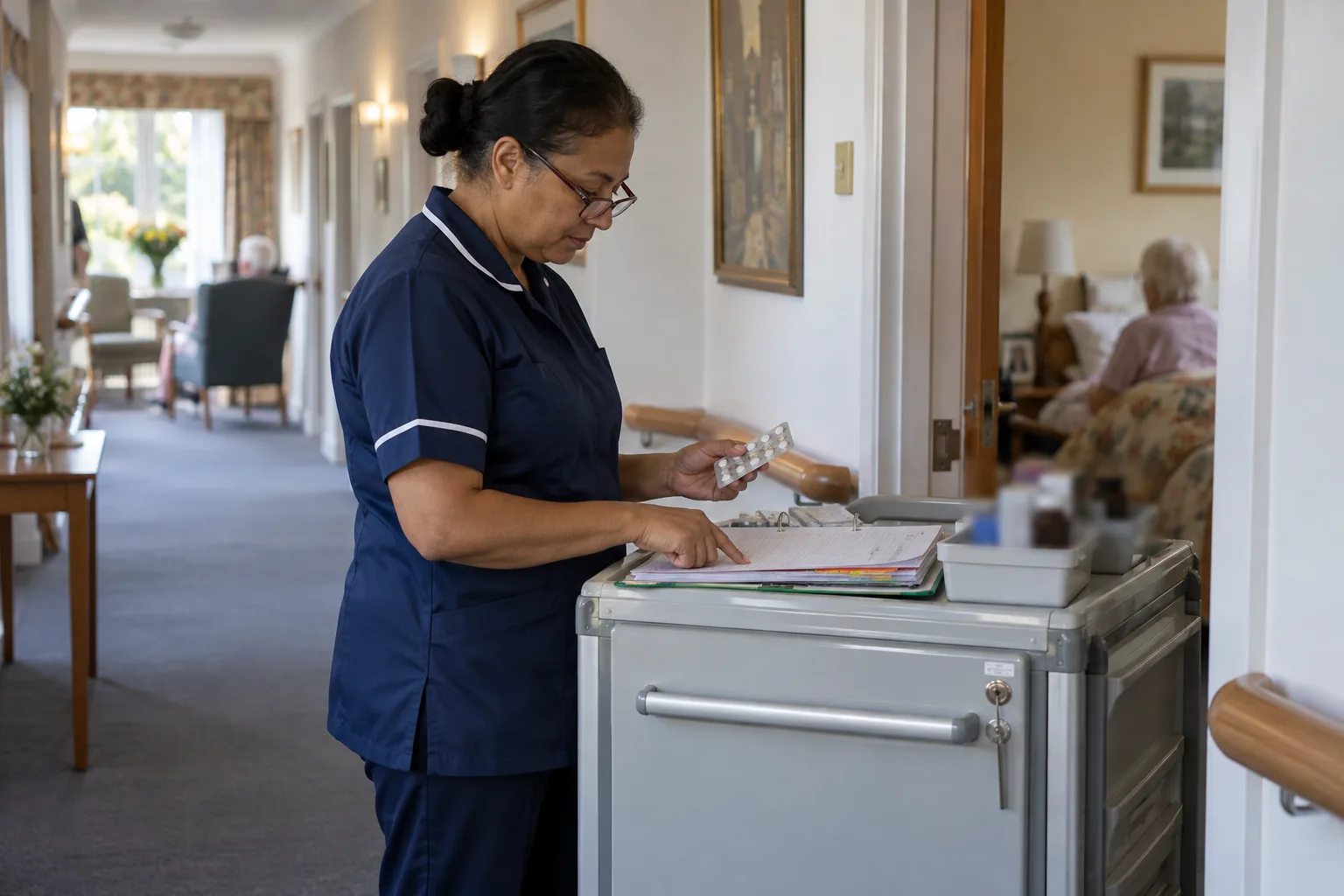
It is the page a senior carer signs at the trolley and the record that shows whether a dose was given, refused or missed. This guide sets out what NICE and CQC say a MAR chart must show, how to complete it, how 'when required' doses, refusals and handwritten entries are recorded, how long to keep it, and where medicines decisions go missing before they ever reach it.
What a MAR chart is, and whose rule it is
A MAR chart is the medicines administration record: the paper or electronic chart on which care staff record each medicine given to, taken by or declined by a person receiving care. CQC's guidance on Medicines administration records in adult social care says adult social care providers "must maintain secure, accurate and up-to-date records about medicines for each person receiving medicines support", to meet Regulation 17 (good governance) and Regulation 12 (safe care and treatment).
Both regulations are in the Health and Social Care Act 2008 (Regulated Activities) Regulations 2014. Regulation 12(2)(g) makes "the proper and safe management of medicines" part of providing care in a safe way. Regulation 17(2)(c) requires a provider to "maintain securely an accurate, complete and contemporaneous record in respect of each service user, including a record of the care and treatment provided to the service user and of decisions taken in relation to the care and treatment provided".
The detail comes from two NICE guidelines that CQC points providers to: Managing medicines in care homes (NICE SC1), published in March 2014, and Managing medicines for adults receiving social care in the community (NICE NG67), published in March 2017, which covers home care. NICE mostly says "should"; where it says "must", this guide says so too.
This guide covers England; Wales, Scotland and Northern Ireland have their own regulators and medicines guidance.
What a MAR chart must show
For care homes, NICE SC1 recommendation 1.14.8 says providers should ensure that medicines administration records, paper-based or electronic, include:
- the resident's full name, date of birth and weight (if under 16 years or where appropriate, for example frail older residents)
- each medicine's name, strength, form and dose, how often it is given and the route of administration
- known allergies and reactions to medicines or their ingredients, and the type of reaction
- when the medicine "should be reviewed or monitored (as appropriate)"
- any support the resident needs to keep taking it (adherence support)
- any special instructions, such as taking it before, with or after food
For home care, NICE NG67 recommendation 1.5.5 adds any person-specific identifiers, such as the NHS number, the name of the person's GP practice and any stop or review date. NICE SC1 recommendation 1.14.15 says care home staff should contact the resident's GP to find out about any allergies and intolerances, and record them accurately on the MAR.
The chart should ideally come from the pharmacy rather than be written by hand. NICE SC1 recommendation 1.11.3 says supplying pharmacies "should produce medicines administration records wherever possible", and NICE NG67 recommendation 1.5.3 says a home care MAR should ideally be a printed record provided by the supplying pharmacist, dispensing doctor or social care provider.
Where a medicine has its own administration record – warfarin, insulin, a patch or a topical cream – NICE SC1 and CQC both say to add a cross-reference on the MAR, for example "see warfarin administration record". Medicines given by a visiting health professional, such as a community nurse, should also be recorded on the resident's MAR.
Completing it: signatures, doses not given and handwritten entries
NICE SC1 recommendation 1.14.7 says a paper or electronic MAR should be legible, signed by the care home staff, clear, accurate and factual, correctly dated and timed, completed as soon as possible after administration, free of jargon and abbreviations, and easily understood by the resident, their family member or carer.
Recommendation 1.14.11 is phrased as a duty: care home staff "must record medicines administration, including the date and time, on the relevant medicines administration record, as soon as possible". It asks staff to:
- make the record only when the resident has taken their prescribed medicine
- complete the administration before moving on to the next resident
- recognise that mistakes are less likely if one member of staff records administration rather than two
- record 'when required' medicines only when they have been given, noting the dose and, where possible, the amount left
- record when and why medicines have not been given
- correct mistakes with a single line through, followed by the correction and a signature, date and time – never correction fluid
Doses not given. Neither NICE nor CQC sets a national list of codes for a dose that was refused, withheld or unavailable, and CQC says "there is no standard format for a medicines record". Whatever key a chart uses, the record has to show when and why the dose was not given. NICE SC1 recommendation 1.2.3 says staff should record the circumstances and reasons for a refusal in both the care record and the MAR, unless there is already an agreed plan for when that resident refuses, and, if the resident agrees, tell the prescriber about any ongoing refusal and inform the supplying pharmacy. CQC reminds providers that "a person with mental capacity has the right to refuse medicines, even if this decision appears ill-judged".
Handwritten entries and transcription. NICE SC1 recommendation 1.14.9 says a new handwritten MAR should be produced "only in exceptional circumstances", by a member of staff with the training and skills for managing medicines and designated responsibility for them, and "checked for accuracy and signed by a second trained and skilled member of staff before it is first used". CQC repeats the two-person check and adds that only people trained and assessed as competent should make and check any changes. If a medicine changes mid-cycle, CQC says to make a new entry so it is clear when it changed.
Changes made by telephone. NICE SC1 recommendation 1.9.7 says a prescription change or new medicine given by telephone should be supported in writing before the next or first dose, and the MAR and care plan updated as soon as possible, usually within 24 hours. For home care, NICE NG67 recommendation 1.4.6 asks providers to record who requested a verbal change, when, and who received it, to read it back to the prescriber, and where possible to have it repeated to someone else.
Home care. CQC says care workers should record each time they provide medicines support, and that this must be "for each individual medicine on every occasion", including who administered it and whether the person took or declined it. Where a worker records "blister pack given" from a compliance aid, the service must keep an accurate record of the individual medicines in the pack, dated and kept with the medicines record. Where a person manages their own medicines and the care plan says so, CQC says the individual doses do not need recording.
PRN medicines, medicines given without the person's knowledge, and controlled drugs
'When required' (PRN) medicines. CQC's guidance on 'When required' medicines in adult social care says that when staff give a PRN medicine the record should include the reason for giving it, how much was given (including where a variable dose is prescribed), the time for time-sensitive medicines, and the outcome and whether it worked. The care plan should give the condition, the maximum dose in a day, the minimum interval between doses and the signs to look for, and in care homes staff should not limit PRN doses to medicines rounds or the times printed on the MAR.
Medicines given without the person's knowledge. NICE SC1 section 1.15, "Care home staff giving medicines to residents without their knowledge (covert administration)", says this should not happen if the resident has capacity to make decisions about their treatment and care. CQC's page "Covert administration of medicines" says it is only likely to be necessary or appropriate where a person actively refuses a medicine, is assessed under the Mental Capacity Act 2005 as lacking capacity to understand the consequences of refusing, and the medicine is essential to their health and wellbeing. The best-interests decision "must not be taken alone": CQC names care staff, the prescriber and a family member or advocate, and NICE adds the pharmacist. CQC says the need must be identified for each medicine, and again whenever a medicine is added or a dose changes; that the MAR "should clearly record which medicines you administer covertly and when"; and that the prescriber must be told if a tablet is crushed or a capsule opened, which may make its use off-licence.
Controlled drugs are a separate record. CQC's guidance on Controlled drugs in care homes says any movement of a Schedule 2 controlled drug – receipt, administration, disposal and transfer – must be recorded in a controlled drugs register, a bound book with numbered pages or a permitted electronic register. Entries must be made as soon as possible on the same day, in chronological order, and should not be cancelled, altered or crossed out. NICE SC1 recommendation 1.14.16 says the member of staff giving the controlled drug and a trained witness should sign the register, and the one giving it should also sign the MAR; CQC says the person's name and the dose and time also go on the MAR.

Paper or eMAR, how long to keep it, and what CQC looks for
eMAR v paper. NICE's recommendations apply to "paper-based or electronic" records alike. CQC's guidance on Electronic medicines administration records (eMAR) in adult social care says a system should not create a barrier to CQC, whose inspectors may view records on a portable device, a desktop or a print-out. Among its questions: what happens if the system or the internet goes down?
How long to keep MAR charts. CQC's guidance says to "keep medicines administration records for adults for at least 8 years after the person's care ended at the service", then review them and, if they are no longer needed, destroy them in line with local policies. The Records Management Code of Practice retention schedule for care records lists "Adult social care records (including care plans)" with a retention period of 8 years and the disposal action "Review and destroy if no longer required".
What CQC looks for. CQC's guidance on Regulation 12: Safe care and treatment says medicines must be "administered accurately, in accordance with any prescriber instructions and at suitable times", that staff who manage medicines must be suitably trained and competent, and that medicines policies should address supply and ordering, storage, administration, disposal and recording. Its guidance on Regulation 17: Good governance says care records must be "complete, legible, indelible, accurate and up to date", including "correspondence and changes to care plans following medical advice". Read a MAR as an inspector might, against the stock and the care plan: look for missing signatures, PRN doses with no reason or outcome, handwritten entries with one signature and changes with no record of who asked.
CQC's page on Good governance of medicines expects "a regular review of medicines processes with records of any actions required". A regular MAR audit – a sample of charts checked against stock and care plans, with actions dated and signed off – is one straightforward way to show it.
"Can you give Mum her tablets later tonight?" – the change that never reaches the chart
Many medicines problems start in a message, not at the trolley. A daughter texts the deputy manager to ask whether her mother's evening tablets can wait until after a visit. The pharmacy texts that a strength is out of stock. A senior carer answers "no problem" from her own phone at the end of a shift, and neither the MAR nor the care record shows that anything was asked or agreed.
NICE SC1 recommendation 1.4.1 says the care home's process for keeping medicines records accurate should cover "recording information from correspondence and messages about medicines, such as emails, letters, text messages and transcribed phone messages", and recommendation 1.9.8 says text messaging "should be used in exceptional circumstances only", with a process in the medicines policy for recording the details. CQC says care home staff should update the record "when they receive correspondence and messages about medicines", and that home care services must have clear processes for recording any change to a person's medicines, "including who requested the change and when". A message that changes a dose or a time belongs in the medicines record; on a personal phone, the service cannot produce it when an inspector asks why the 18:00 dose was signed at 21:30.
ComplyChat is not an eMAR, a medicines management system or a care record, and it is not where a prescription change is authorised; that stays with the prescriber, in writing, and on the MAR. It provides a channel for the work conversations around the chart – the deputy manager, the senior carer on nights, the pharmacy and a family member with no account on the home's systems – with everyone added told the channel is on the record. On paid plans, the lasting record files into the provider's own Microsoft 365 once the archive is connected and filing. ComplyChat Free is a permanent personal tier with one private group, direct messages and three calendar months of recent history, and no Microsoft 365 archive or Replay; upgrading cannot restore expired history, and Free does not meet a retention duty.
A question for the next leadership or clinical governance meeting: when a family member, a GP surgery or a pharmacy last asked us by text to change the time or dose of a medicine, can we show the message, who answered it and the MAR entry that followed, without asking anyone to scroll back through their own phone?
Questions people ask
What does MAR stand for in medication?
MAR stands for medication, or medicines, administration record: the chart on which care staff record every dose of a medicine given, taken or declined.
How do you complete a MAR chart?
Complete the MAR chart as soon as possible after the person has taken the medicine, and only once they have taken it, with the date, time and your signature. NICE SC1 recommendation 1.14.11 also asks staff to record when and why a dose was not given.
What should be included on a medication administration record?
A medication administration record should include the person's full name and date of birth, each medicine's name, strength, form, dose, frequency and route, known allergies and any special instructions, such as taking it with food. NICE SC1 recommendation 1.14.8 sets the full list for care homes, and NICE NG67 recommendation 1.5.5 for home care.
Can a carer give medication without a MAR chart?
Not without recording it: NICE NG67 recommendation 1.5.2 says home care workers must record medicines support "for each individual medicine on every occasion", in line with Regulation 17, and recommendation 1.5.3 says they should use a medicines administration record to do so. The exception is a person who manages their own medicines, where CQC says the care plan should state this and individual doses need not be recorded.
Why would someone have a MAR chart?
A person has a MAR chart when a care home or home care service gives or supports them to take their medicines. CQC's description of medicines support runs from reminding a person to take a medicine to administering some or all of it.
Official guidance and your next step
Every document quoted here is listed under Sources below. Quotations are from those documents as published on 28 September 2026; check the current versions before relying on them.
This guide summarises published guidance for England; it is not clinical or legal advice. Your supplying pharmacy and local medicines optimisation team can advise on a specific chart.
Then do one thing: take three MAR charts from last week and, for each, find one dose that was changed, refused or given 'when required'. Check that the chart says why, who agreed it and where the instruction came from. Then ask the staff on duty how that instruction reached them.
We build ComplyChat for the work conversations organisations need to keep. A MAR chart must be exact, and the instructions that change it often arrive as messages. ComplyChat does not do care planning, charts, rostering or medicines; it gives those messages somewhere the service controls. Explore Free personal messaging, or compare the paid plans if your organisation needs a lasting Microsoft 365 archive.
Sources
Every document this guide quotes or links to, in the order it first cites them.
- Medicines administration records in adult social care cqc.org.uk
- Health and Social Care Act 2008 (Regulated Activities) Regulations 2014 legislation.gov.uk
- Regulation 17(2)(c) legislation.gov.uk
- Managing medicines in care homes (NICE SC1) nice.org.uk
- Managing medicines for adults receiving social care in the community (NICE NG67) nice.org.uk
- 'When required' medicines in adult social care cqc.org.uk
- "Covert administration of medicines" cqc.org.uk
- Controlled drugs in care homes cqc.org.uk
- Electronic medicines administration records (eMAR) in adult social care cqc.org.uk
- Records Management Code of Practice retention schedule for care records digital.nhs.uk
- Regulation 12: Safe care and treatment cqc.org.uk
- Regulation 17: Good governance cqc.org.uk
- Good governance of medicines cqc.org.uk