No single regulation is called the missing person rule. The duty is assembled from the fundamental standards on safe care, safeguarding and records, from the police definition of a missing person, and from a national multi-agency framework that most local protocols follow. This guide sets out what the policy has to say, what to do in the first hour, what goes to whom, and the record that shows it was done.
The rules a missing person policy rests on
A care home’s missing person policy rests on three fundamental standards in the Health and Social Care Act 2008 (Regulated Activities) Regulations 2014, a police definition and a national framework, not on one regulation of its own. Regulation 12 requires care to be provided “in a safe way”, which includes “assessing the risks to the health and safety of service users of receiving the care or treatment” and “doing all that is reasonably practicable to mitigate any such risks”; a resident who may leave without being able to keep themselves safe is one of those risks. Regulation 13(5) adds that “a service user must not be deprived of their liberty for the purpose of receiving care or treatment without lawful authority”, which is why the policy cannot simply be locked doors. Regulation 17 requires an accurate, complete and contemporaneous record of the care provided “and of decisions taken in relation to the care and treatment provided”, and a missing episode is a run of decisions taken quickly.
The police definition is deliberately wide. The College of Policing’s authorised professional practice on missing persons says: “Anyone whose whereabouts cannot be established will be considered missing until they are located and their wellbeing is confirmed.” It also says that “adults with capacity have a legal right to go missing”, and that “parents and care providers, for both children and adults, are expected to take reasonable steps to locate the missing person before making a report to the police”.
The third source is The multi-agency response for adults missing from health and care settings: a national framework for England, published on GOV.UK in November 2021 and endorsed by the Minister for Safeguarding. It covers people who go missing “from health and care settings including hospitals and residential care homes”. It is candid about its status: “It is not a statutory document in itself and the processes and recommended practice are not compulsory for local areas to adopt.” It is the basis of most local missing adult protocols, so a care home’s policy should follow its local protocol first and the framework where the protocol is silent. The framework recommends that each area run two multi-agency groups through its existing partnership arrangements: a strategic oversight group that develops the local protocol and reviews missing statistics, and an operational group of frontline professionals that holds regular meetings to review “individual missing incidents and locations from which those incidents are reported”. A home with repeated episodes should expect to be discussed there, and its own records are what those agencies will read. The framework also states the limit every policy has to respect: “Adults generally have a right to go missing unless they have been detained under the Mental Health Act, or are subject to a Deprivation of Liberty Safeguard.”
What the policy should cover
A missing person policy is mostly about the hours before anyone goes missing. The framework’s sections on prevention, reporting and return give it a natural shape:
- Who is at risk, and the plan for each of them. The care plan and risk assessment record whether a resident is at risk of leaving, the triggers, and what the home has agreed with them. The framework recommends a conversation on admission for people at higher risk, covering “when someone would be reported missing and what this will mean”, places they might go and who to contact, with the result “incorporated into people’s care plans or used to develop a trigger plan”.
- A one-page profile kept ready. The framework lists what helps the police: “a recent photograph”, a full description and what the person was last seen wearing, places they like to visit, relevant medical or mental health conditions, medication they take or need, behaviour patterns, how to approach them when found, previous missing episodes and contact information. Many forces run the Herbert Protocol for people living with dementia, which the framework describes as “a form developed by the police that carers, family or friends of a person living with dementia can fill in and share with the police”. Check your local force’s version and keep the completed form with the care plan.
- The first-response steps, in order, with who leads on each shift and how the manager is reached at night (section 03).
- The escalation test: when the person in charge reports to the police, and that the decision is agreed with a senior colleague without delaying an urgent call (section 04).
- Who is told: police, family or representative, CQC, the local authority safeguarding team, and any commissioner whose contract requires notice (section 05).
- The return: welfare checks, the conversation on return, and the care plan review.
- Training: the framework says staff should “understand the policy under which they are expected to act and the decision-making process they are expected to follow when considering risk and deciding when to escalate”, and “understand the police’s responsibilities and powers when someone is reported missing”.
Practical changes to the building belong in the policy too. The framework gives examples “from moving outdoor furniture in a smoking area to reduce the chance of someone climbing over a wall, to introducing a more secure exit with staff who will be able to engage with the individual”. For a resident whose liberty is restricted, those changes have to sit inside a lawful authorisation, which our guide to DoLS record keeping covers.
The first hour: search, enquiries and the decision to call
The framework draws one line first: “When there is critical concern for someone’s safety they should always be reported missing to the police immediately and the reason for concern should be thoroughly explained to ensure an appropriate level of response.” A resident with advanced dementia gone into the night in January, someone who needs medication within hours, or someone who has spoken of harming themselves does not wait for a search to finish.
Where the concern is not critical, staff make initial enquiries, which the framework says should include:
- checking the person’s care plan or other relevant information;
- calling the person’s mobile phone and any other contact numbers;
- contacting appropriate next of kin;
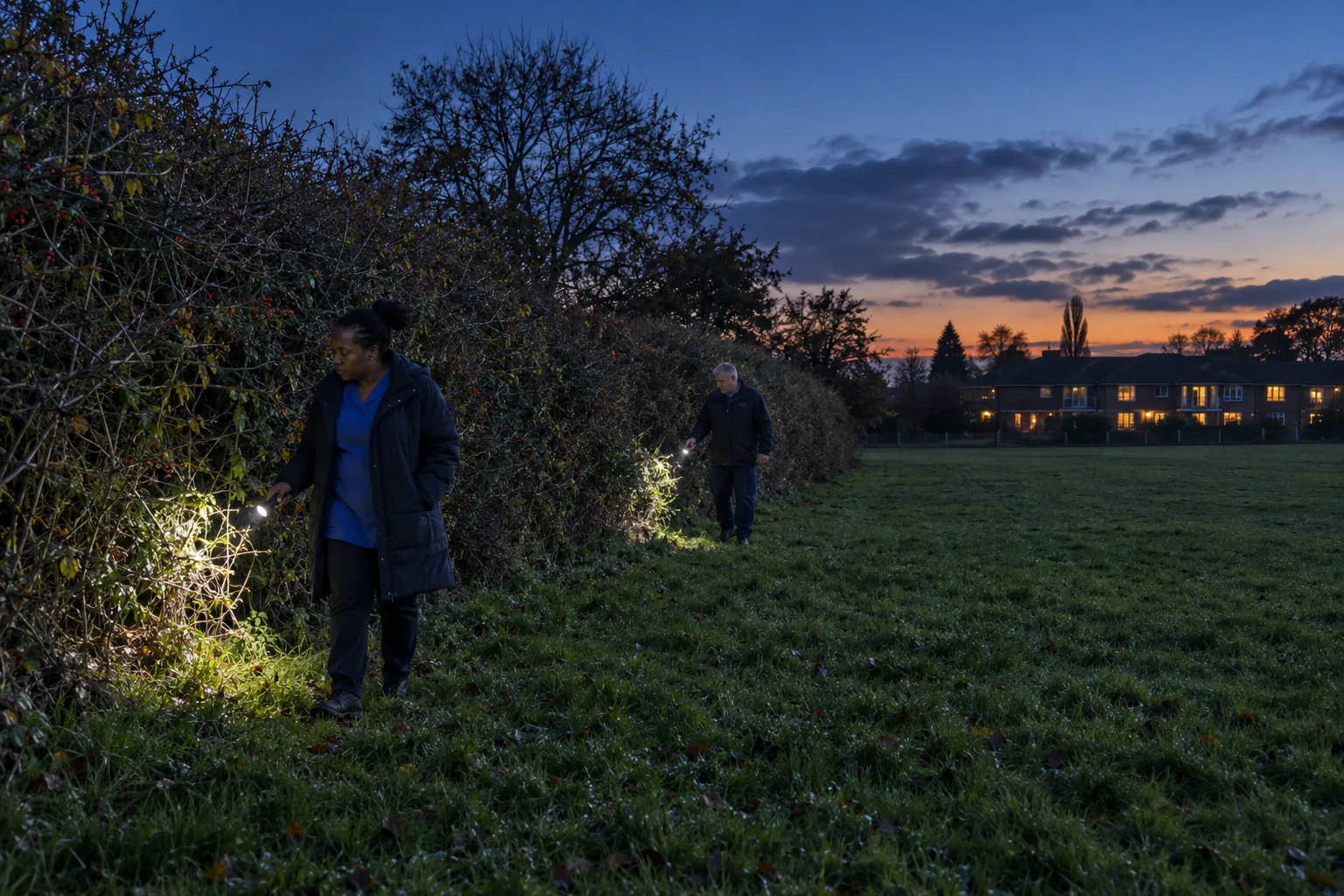
- searching the immediate area, and informing other staff members;
- speaking to other residents to establish any recent events that may be relevant;
- checking CCTV recordings for possible sightings or signs that the person has left the premises;
- “recording the actions that have been taken, people who have been spoken to, and the rationale for any decisions about risk and when to escalate to another agency or not”.
No national rule sets a number of minutes after which a care home must call the police, and a policy that says “after 15 minutes” has chosen its own figure. The test in the framework is the person, not the clock: report “if there is now critical concern for their safety, if they are detained under the Mental Health Act”, or if they have not returned and there is concern that they will not return or will suffer serious harm while away. The decision to report “should be agreed with an appropriate (in some cases more senior) member of staff”, but “this process should not contribute to delays in reporting if there are immediate, serious concerns about someone’s safety”. Write the decision down with its time and the name of the person who made it, including a decision not to call yet and when it will be reviewed.
Short absences still need a record. The College of Policing says: “There will be occasions where children or adults go missing from care for short periods and are located without the incident being reported to the police. In these circumstances, the care provider is responsible for recording the incident and documenting any information about the individual’s whereabouts while away.” A third short absence in a month should show up as a pattern, not as three unrelated notes.
Reporting to the police and working with them
When the home reports a resident missing, the police assess the risk. The College of Policing’s risk assessment guidance uses four levels, from very low to high, and describes high risk as “the risk of significant harm to the subject or the public is assessed as very likely”, which “almost always requires the immediate deployment of police resources”. The quality of that assessment depends on what the caller can tell them. The framework warns that “it is a serious issue that could lead to significant harm for an individual if all known information cannot be provided in a timely way”, which is why the one-page profile matters more than any other document in the policy.
The framework also asks the reporting person to “provide a point of contact to the police for ongoing updates”, and to consider how that contact survives a change of shift. Once the police have recorded the report and assessed the risk, they “assume responsibility for the investigation and any physical search”, but the home keeps three jobs:
- passing on anything new, such as a sighting, a call from a relative or a change in what the missing medication means;
- reviewing and retaining CCTV and sharing what is relevant: “If CCTV is available within the hospital or care setting this should be reviewed, retained and any pertinent information shared with the police”;
- further searches of the building and grounds, which the framework says should be guided by the police “to ensure that the missing person is not still on the premises”.
The framework adds that any further action the home takes “should be recorded, similarly to the actions taken before reporting to the police as this may later need to be reviewed”.

CQC, safeguarding, the family and the return
CQC. There is no CQC notification form for a missing care home resident as such. CQC’s unauthorised absence form is, in CQC’s words, only for services “with a specific security designation of low, medium or high security”, about a person detained under the Mental Health Act. For a care home the route is regulation 18 of the Care Quality Commission (Registration) Regulations 2009, which requires the registered person to notify CQC “without delay” of “any incident which is reported to, or investigated by, the police”. Read on its plain words, that covers a resident reported missing to the police (CQC’s police notification page does not mention missing residents, but describes the notification as being for “an incident relating to your service that is reported to or investigated by the police”), and the form is Police involvement in an incident. CQC’s page adds an exception: where a person using the service was affected by a death, serious injury or abuse, use that event’s own form instead. Our guide to CQC notifications covers the forms and the portal.
Safeguarding. The 2009 Regulations define abuse to include “neglect and acts of omission which cause harm or place at risk of harm”. A resident who left through a door that the care plan said should be alarmed, or who went missing while the staff the rota showed were not on duty, may be a safeguarding concern as well as an incident. Where the local authority has reasonable cause to suspect that an adult with care and support needs is experiencing or at risk of abuse or neglect and cannot protect themselves, section 42 of the Care Act 2014 requires it to make whatever enquiries it thinks necessary; our guide to the section 42 enquiry covers the provider’s part. An allegation of neglect is also notified to CQC on its own form.
The family. The framework says that, if appropriate, next of kin “should be informed of the incident”, staff “should listen to any concerns from them”, and “from this point onwards they should be kept updated and involved with the investigation where possible”. Where the resident came to harm, consider whether the duty of candour under Regulation 20 also applies.
RIDDOR, usually not. HSE’s sector information sheet gives a near-identical example as not reportable: “An elderly woman with dementia wanders out of a care home into the car park/main road.” An injury suffered while away is a separate question with its own test; our guide to incident reporting in care homes sets out how the five reporting duties fit together.
The return. The framework is firm that being found is not the end: “In most situations adults have the right to go missing and crucially they have not done anything wrong by doing so.” The police may hold a prevention interview, and the home should hold its own conversation on return, which the framework says should be non-judgemental, timely, open, flexible and actioned: “If people raise concerns about their care, frustrations with the limitations put upon them by professionals, or any information about external harm, efforts should be made to make changes and/or ensure their safety.” The police guidance asks officers to consider “push and pull factors”: push factors “drive a person away, such as abuse, neglect, conflict or financial problems”, and the honest version of that question in a care home is whether something in the resident’s care, routine or relationships made them want to leave. Then review the care plan, the safety planning and the risk assessment with the resident and their family, and close the record with what changed.
“Has anyone seen Mr H?” – where the first hour is recorded
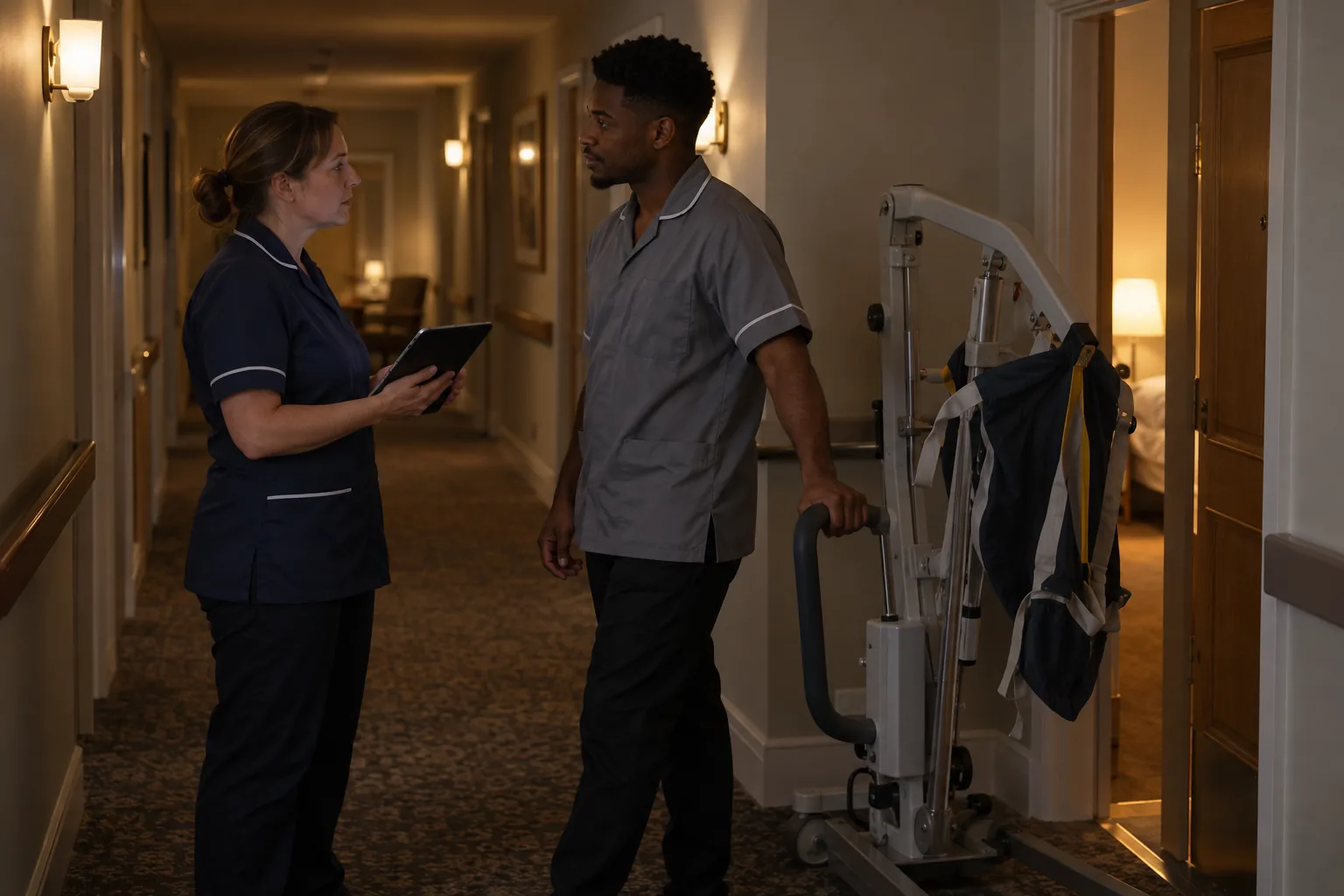
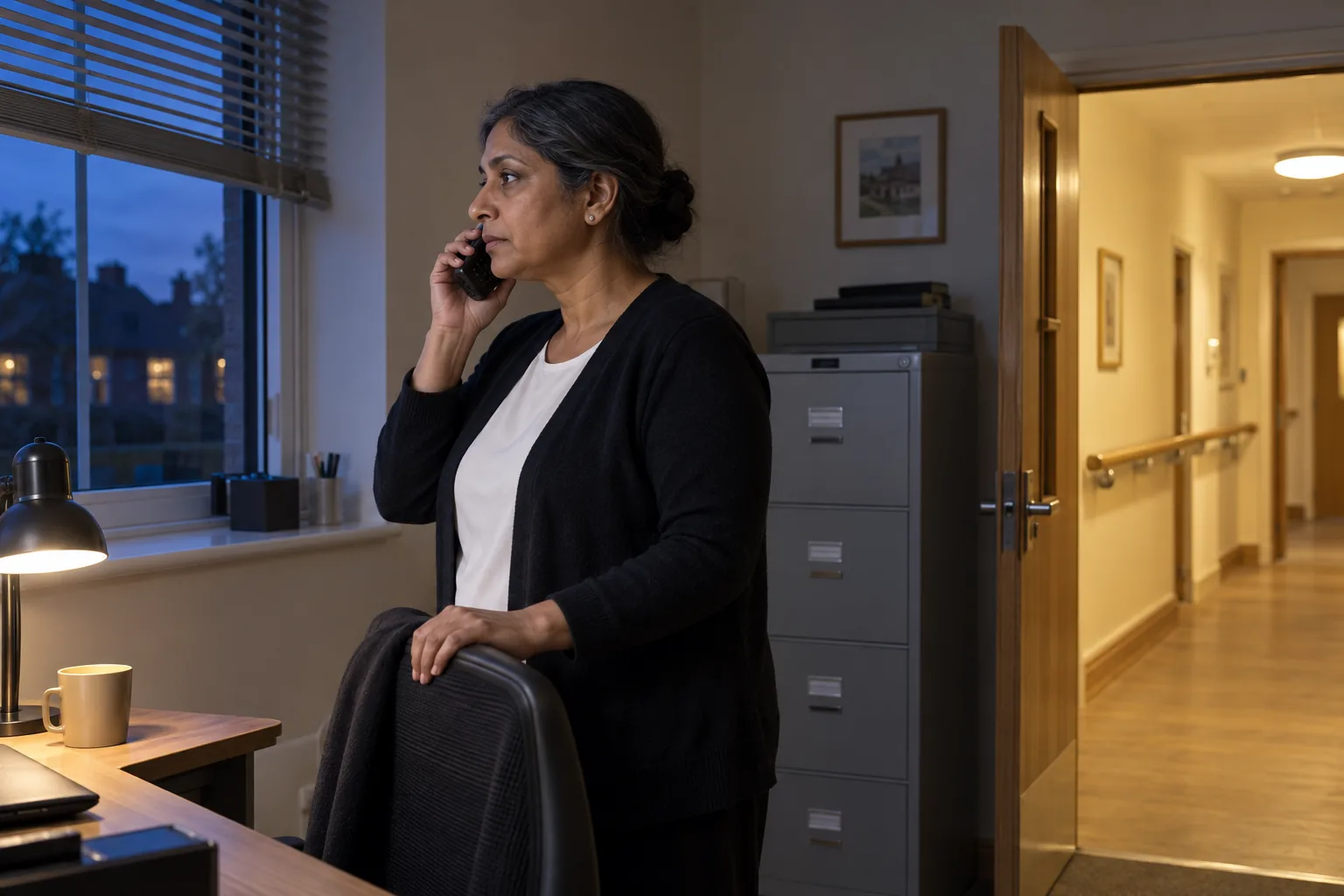
Read the framework’s list of initial enquiries again and notice where each one happens. The carer who finds the empty bedroom messages the senior upstairs. The senior posts in the staff group: “Mr H not in his room, everyone check your area.” Replies come back over twenty minutes: lounge clear, garden clear, side gate found open. The night manager, called at home, replies by text that she is on her way and to ring the police. The daughter is told by a message from the senior’s own phone, and replies with the name of the café her father used to walk to.
Every element the framework asks the home to record – the actions taken, who was spoken to, the rationale for decisions about risk and when to escalate – is in that exchange, timed to the minute. The police risk assessment depends on it, the CQC notification draws on it, and a later safeguarding enquiry into the open gate will ask for it. In most homes it sits on four or five personal phones, in an app the provider does not control, and the written record is reconstructed the next morning by someone who was not there for half of it.
The answer is not to stop staff messaging during a search; speed is the point, and the message is the search. It is to give that conversation a place the provider controls, with the manager in it from the first message, everyone in it told it is on the record, and every message kept as it was sent. ComplyChat provides a work channel of that kind; a mobile number verified by SMS is an identity on it, which matters at night when the people searching are bank or agency staff with no work account, and on paid plans the lasting record files into the provider’s own Microsoft 365. It is not a missing person system, it does not contact the police, and it does not decide when a resident is missing; the person in charge does.
A question for the next managers’ meeting: take your last missing episode, however short. Could the home produce, today, the messages in which it was first reported, searched for and escalated – or only the summary written afterwards?
Questions people ask
Is a missing person a safeguarding issue?
A missing resident is always a safety concern and can be a safeguarding concern: the College of Policing says “going missing is often an indicator that an individual may be at risk of harm”, and the national framework says missing “may be an indicator of a range of serious harms in a person’s life”. Where neglect may have contributed, or harm was suffered while away, consider raising a safeguarding concern with the local authority, which decides whether its section 42 enquiry duty under the Care Act 2014 applies, and the matching CQC notification.
How long until a person is considered missing in the UK?
There is no waiting period: the College of Policing’s definition is that “anyone whose whereabouts cannot be established will be considered missing until they are located and their wellbeing is confirmed”. For a care home the question is when to report, and the national framework says a resident should be reported to the police immediately where there is critical concern for their safety.
Do care homes have to tell CQC when a resident goes missing?
On the wording of the regulation, yes, once the police are involved: regulation 18(2)(f) of the Care Quality Commission (Registration) Regulations 2009 requires notification without delay of “any incident which is reported to, or investigated by, the police”, made on CQC’s Police involvement in an incident form. CQC’s unauthorised absence form applies only to secure mental health services, and a missing episode that involved a death, serious injury or abuse is notified on that event’s own form.
What is the Herbert Protocol?
The Herbert Protocol is a police scheme for people living with dementia: a form that carers, family or friends complete in advance with the information the police need if the person goes missing, such as medication, places they have previously been found and a recent photograph. The national framework says having it ready “saves time for the police, allowing the search to start sooner”; forms and arrangements vary by police force, so use your local force’s version.
Official guidance and your next step
The primary sources are the national framework for adults missing from health and care settings, the College of Policing’s authorised professional practice on missing persons, regulations 12, 13 and 17 of the 2014 Regulations, regulation 18 of the 2009 Registration Regulations with CQC’s police involvement form, and HSE’s HSIS1 information sheet. Your local safeguarding adults board and police force will publish the local missing adults protocol, which takes precedence on local detail.
This guide is a practical summary for registered managers and providers in England, not legal advice about an individual resident, a deprivation of liberty or a safeguarding enquiry.
Then do one thing: pick the three residents most at risk of leaving and check that each has a current one-page profile with a recent photograph, kept where the night staff can reach it in under a minute.
We build ComplyChat for the work conversations organisations need to keep. A missing resident is the sharpest case we know of a decision made in minutes, in messages, that later has to be shown step by step to the police, CQC and a family. Explore Free personal messaging, or compare the paid plans if your service needs a lasting Microsoft 365 archive.
Sources
Every document this guide quotes or links to, in the order it first cites them.
- Health and Social Care Act 2008 (Regulated Activities) Regulations 2014 legislation.gov.uk
- Authorised professional practice on missing persons college.police.uk
- The multi-agency response for adults missing from health and care settings: a national framework for England gov.uk
- Risk assessment guidance college.police.uk
- Regulation 18 of the Care Quality Commission (Registration) Regulations 2009 legislation.gov.uk
- Police involvement in an incident cqc.org.uk
- Care Act 2014 legislation.gov.uk
- HSIS1 information sheet hse.gov.uk