
The term itself is not in statute: it comes from research now based at Durham University; the statutory guidance calls the harm “extra-familial harm”, and KCSIE links to Contextual Safeguarding as further information. What KCSIE does ask of a school is concrete. All staff, and especially the designated safeguarding lead, should consider whether children are at risk in situations outside their families; concerns, discussions and decisions should be recorded with their reasons; and it is important that a referral carries as much information as possible – in practice where, when, with whom, on which platform – so that social care can see the harm in the place it happens. This guide sets out what the guidance says, what harm outside the home covers, what the school's part is, and what a record needs to hold so that the DSL can see a pattern across pupils.
What contextual safeguarding means, and what KCSIE 2026 says
Contextual safeguarding is a framework for responding to harm that children experience outside their homes, developed by Professor Carlene Firmin and now run as a programme at Durham University; Keeping children safe in education 2026 (KCSIE) links to it, but neither KCSIE nor any statute makes it a legal duty. The Contextual Safeguarding programme's own site says the framework was “Developed over a decade ago by Professor Carlene Firmin” and is “focused on ensuring all young people have safe and joyful lives with their friends, at school, online and in their communities”. It adds that the programme and its team “are based at the University of Durham”; its resources were produced at the University of Bedfordshire until September 2021, then jointly with Durham until June 2022, and at Durham since.
The statutory guidance in England uses a different phrase for the harm itself. Paragraph 216 of Working Together to Safeguard Children 2026 says: “Some children experience abuse and exploitation outside the home. This includes children who are looked after and live in residential or foster care. This type of harm is often referred to as “extra-familial harm”.” Its glossary adds: “While there is no legal definition for the term extra-familial harm, it is widely used to describe different forms of harm that occur outside the home.”
Two paragraphs of Keeping children safe in education 2026, in force from 1 September 2026, carry the idea into schools:
- Paragraph 21, in Part one for all staff: “All staff, but especially the designated safeguarding lead (and deputies) should consider whether children are at risk of abuse or exploitation in situations outside their families. Extra familial harms take a variety of different forms and children can be vulnerable to multiple harms”.
- Paragraph 66, on referrals to children's social care: “Local authority children's social care assessments should consider where children are being harmed in contexts outside of the home, so it is important that schools and colleges provide as much information as possible as part of the referral process. This will allow any assessment to consider all the available evidence and enable a contextual approach to address such harm. Additional information is available here: Contextual Safeguarding.”
Read the verbs. KCSIE says it uses “must” when “the person in question is legally required to do something” and “should” when “the advice set out should be followed unless there is good reason not to”, and schools and colleges in England “must have regard to it”. Paragraph 21 is a “should consider”, and paragraph 66 says it is “important” that schools give as much information as possible. So a school is not required to “adopt contextual safeguarding” as a model. It is expected to think about harm outside the family, to put the context into its referrals, and to record what it knew and decided.
Extra-familial harm: the forms it takes and where it happens
Working Together 2026 paragraph 216 lists the forms of extra-familial harm: “child criminal exploitation (such as county lines and financial exploitation), serious violence, modern slavery and human trafficking, online harm, sexual exploitation”, including group-based child sexual exploitation, as well as teenage relationship abuse and “the influences of extremism which could lead to radicalisation”. It adds: “Children of all ages can experience extra-familial harm.” The same paragraph says harm can come “from other children and/or from adults” and “may be perpetrated by individuals or groups”. KCSIE paragraph 21 gives the school's version of the list, naming sexual abuse (including harassment and exploitation), domestic abuse in children's own intimate relationships, criminal exploitation, “serious youth violence”, county lines and radicalisation.
The places matter as much as the harms. The Working Together glossary defines extra-familial contexts as “peer groups, school, and community/public spaces, including known places in the community where there are concerns about risks to children (for example, parks, housing estates, shopping centres, takeaway restaurants, or transport hubs), as well as online, including social media or gaming platforms.” In practice that gives a school four kinds of context to notice:
- Peer groups – a friendship group that changes suddenly, an older group a pupil has started spending time with, or harm between children in the same group.
- The school itself – corridors, toilets, the school bus, the lunch queue: KCSIE paragraph 571, on harmful sexual behaviour, asks staff to keep an attitude of “it could happen here”.
- Public places in the neighbourhood – the park, the estate, the shopping centre, the takeaway, the bus or railway station.
- Online spaces – social media, messaging and gaming platforms, which KCSIE's online safety section treats under four areas of risk.
Working Together paragraph 216 adds that this includes children who are looked after and live in residential or foster care: harm outside their placement is extra-familial harm too.
Some children are at greater risk. Working Together paragraph 218 names “children with special educational needs or disabilities, those missing from home, care or education, looked after children, and those with previous experience of abuse or neglect”, and says perpetrators “may purposefully target children who are already vulnerable”. Paragraph 219 says that “All children, including those who may be causing harm to others, should receive a safeguarding response” – a point for any record that describes a pupil who is both at risk and causing harm – and warns that some children who experience harm “can be mistakenly perceived to be older than they are”, so a record should give a child's age as known, not as perceived.
What the school is asked to do
The school does not run a contextual assessment. Working Together paragraphs 220 to 223 describe assessments by children's social care, which decide whether a child is in need under section 17 of the Children Act 1989 or whether to make enquiries under section 47. The school's part is to notice, to share what it knows and to take part. KCSIE 2026 sets that out in five places:
- Notice harm outside the family (paragraph 21). Every member of staff, not only the DSL, should consider it.
- Respond wherever it happens (paragraph 571, Part five). For harmful sexual behaviour, sexual harassment and sexual violence, staff should “respond appropriately to all reports and concerns whether they occur online, offline, or outside of the school/college”, and the DSL's initial response should consider, among other things, “wider contextual concerns, including links to child sexual exploitation (CSE) or child criminal exploitation (CCE).”
- Put the context into the referral (paragraph 66). Give social care “as much information as possible” so the assessment can take a contextual approach.
- Share without fear (paragraph 63). “Data protection laws do not prevent the sharing of information for the purposes of keeping children safe and promoting their welfare.” If in doubt, staff should speak to the DSL or a deputy.
- Escalate if nothing changes (paragraph 73). “If, after a referral, the child's situation does not appear to be improving, the referrer should consider following local escalation procedures”.
Working Together paragraph 222 explains why the referral's detail matters: practitioners “will need to build an understanding of the context in which the harm is occurring, including online and draw on relevant knowledge and information from parents or/carers, children and wider partners”. Its footnote counts among those partners people “who may come into contact with or be aware of the presence of children as they carry out their day-to-day roles in the community”, naming youth workers, business owners, faith and community leaders and park wardens. A school is one of the few organisations that sees the same children every weekday, so its staff often hold the first piece of that picture.
For harmful sexual behaviour specifically, KCSIE lists the Contextual Safeguarding Network's Beyond Referrals (Schools), which “provides a school self-assessment toolkit and guidance for addressing HSB in schools”, in both Part five and Annex A. Annex A also lists the Contextual Safeguarding Network's self-assessment toolkit for schools and the Peer-on-Peer Abuse toolkit from Farrer and Co. and Carlene Firmin, which “provides practical guidance for schools on how to prevent, identify early and respond appropriately to peer-on-peer abuse”; KCSIE's own term is child-on-child abuse, which paragraph 31 says “can happen both inside and outside of school or college and online”. All three are third-party further reading, not statutory guidance.
What goes in the record: contextual safeguarding records
The record rule for every safeguarding concern in a school is KCSIE 2026 paragraph 74: “All concerns, discussions and decisions made, and the reasons for those decisions, should be recorded in writing.” It goes on: “It is good practice to keep concerns and referrals in a separate child protection file for each child.” Records should include “a clear and comprehensive summary of the concern”, “details of how the concern was followed up and resolved”, and “a note of any action taken, decisions reached and the outcome”. Paragraph 75 adds that a member of staff in doubt about recording “should discuss with the designated safeguarding lead (or a deputy)”.
Annex B, on the role of the DSL, sets the standard for what a record says: “Safeguarding records should be clear, factual, and distinguish between observed concerns, professional opinion, and historic information.” For harm outside the home, that distinction carries real weight. For example, “I saw him get into a car outside the leisure centre” is an observation; “I think the older lads are using him” is an opinion; “his previous school raised county lines concerns” is historic information.
KCSIE does not prescribe fields. A contextual concern is easier to act on when the record also captures, as far as the member of staff knows it:
- Where – the place, as precisely as it was described (the bus station's back entrance, not “in town”).
- When – date and time, and whether it was during the school day, on the journey or in the evening.
- With whom – other pupils involved, as a reference to their own file rather than their details, and any adults or older young people seen, described as observed.
- Which online space – the platform, game or group, without copying intimate images or harmful content into the record.
- Who told whom – how the concern reached the school (a pupil, a parent, a bus driver, a youth worker, a message to a member of staff) and what was passed on, to whom and when.
- What was decided and why – including a decision not to refer, which paragraph 74 asks the school to record with its reasons.
Two cautions follow from the other children in a contextual record. First, KCSIE's “separate child protection file for each child” means one child's file should not become a file on the group: record the other children by reference, and record each child's own concern on their own file. Annex B asks the DSL to “ensure the file is only accessed by those who need to see it”. Second, a school that wants to see a context across pupils – a place several concerns mention – may keep a separate log of places and platforms that points to the child files, rather than copying between them. That is a practice, not a requirement; decide it with your DSL and data protection officer.
For a single child's history over time, see the safeguarding chronology guide; for what to send and keep at the point of referral, see the MASH referral guide.
Seeing patterns across pupils, and working with partners
Contextual harm rarely shows itself in one concern. It appears when three records, made by three members of staff about three pupils, mention the same car park, the same older group or the same group chat. KCSIE 2026 paragraph 619, in Part five on child-on-child sexual violence and sexual harassment (under its heading on unsubstantiated, unfounded, false or malicious reports), restating paragraphs 74 and 75, says that “all concerns, discussions, decisions, and their rationale, should be clearly recorded in either writing or digitally. Records should be reviewed so that potential patterns of concerning, problematic or inappropriate behaviour can be identified, and addressed.” That sentence is written for child-on-child reports, but it describes what a DSL can only do if records name places, groups and platforms consistently.
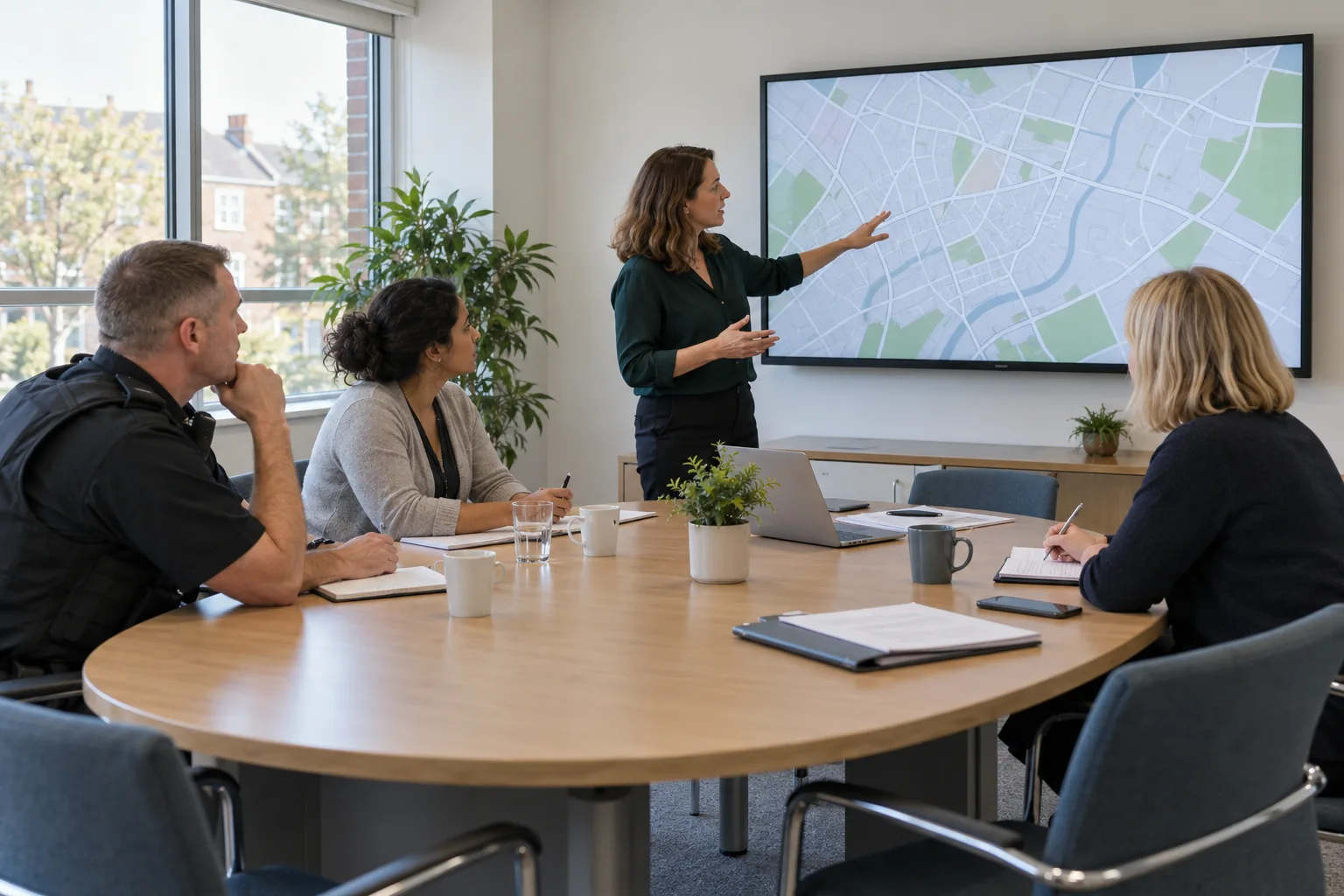
When several pupils share a context, Working Together paragraph 221 says “practitioners should consider the individual needs of each child as well as work with the group”, because “Working with the whole group enables practitioners to build an understanding of the dynamics between those within the group and the extra-familial context.” Paragraph 222 asks practitioners to “identify patterns of harm, risk and protective factors in these contexts”, which “may include working across safeguarding partners, including police forces and community safety partnerships, to agree a plan for keeping children safe, including seeking to identify and disrupt those causing harm”.
Those paragraphs describe the work of children's social care and its partners. A school takes part by bringing what its records show to the strategy discussion, the assessment or the local partnership meeting, and by keeping its own note of what was agreed. Working Together paragraph 223 says “Key decisions should be recorded and communicated to both the child and their parents or carers”; for the school, KCSIE paragraph 74 already asks that its own decisions, and the reasons for them, are in writing.
Some questions a DSL can ask of the school's records each half term:
- Do any places, platforms or names recur across different pupils' concerns?
- Have concerns been raised about children who are already at greater risk – with SEND, missing education, looked after?
- Did each referral that involved harm outside the home carry the place, time and other children, and what happened after it?
- Has any referral stalled, so that the escalation in paragraph 73 should be considered?
Where the first sign of a context usually arrives
The first sign of a harmful context is rarely a concern form. It is a teaching assistant messaging the head of year at five o'clock: “Saw three of our Year 9s at the bus station again with the same older lads.” It is a youth worker texting a pastoral lead whose number they have from a meeting last term. It is a member of the lunch staff mentioning a group chat to a form tutor, who mentions it on to the DSL in a reply. Each of those is safeguarding information about several pupils and a place, and KCSIE paragraph 74 asks for concerns and discussions to be recorded.
If those conversations sit on personal phones, the DSL cannot put them alongside the school's records, cannot see that the bus station has now come up three times, and cannot produce what was said when a referral, a review or a complaint asks for it – paragraph 74 notes that the written record “will also help if/when responding to any complaints”. The fix is not more paperwork; it is making sure the conversations that start a concern happen somewhere the school can see and keep. Paragraph 619's own wording allows records “in either writing or digitally”.
ComplyChat is designed to keep those work conversations on the school's record. Staff, and partners such as a youth worker added by their mobile number, talk in channels the school controls; a mobile number verified by SMS is an identity, so an outside partner needs no account on the school's systems; and everyone added is told the channel is on the record and can object or leave. On paid plans, once the school's tenant is connected, conversations are kept under the retention schedules within its own Microsoft 365 subscription. ComplyChat is not a safeguarding recording system or an MIS: the concern, the referral and the child protection file belong in the system your policy names, and a message is a reason to make that record, not a substitute for it.
A question for the next safeguarding meeting: when a member of staff sees pupils somewhere that worries them after school, how does that reach the DSL, and would it be in the records you review for patterns?
Questions people ask
What is another term for contextual safeguarding?
In England the statutory guidance speaks of “extra-familial harm”: Working Together to Safeguard Children 2026 paragraph 216 says harm outside the home “is often referred to as “extra-familial harm””, and its glossary says “there is no legal definition” for the term. KCSIE 2026 paragraph 21 uses “extra familial harms” too, and paragraph 66 speaks of “a contextual approach” and links to Contextual Safeguarding for further information. Strictly, extra-familial harm is the harm and contextual safeguarding is one way of responding to it.
What are some examples of contextual safeguarding incidents?
Working Together 2026 paragraph 216 lists criminal exploitation such as county lines and financial exploitation, serious violence, modern slavery and human trafficking, online harm, sexual exploitation, teenage relationship abuse and the influences of extremism; its glossary adds child-on-child sexual abuse. The places named in the glossary include peer groups, school, parks, housing estates, shopping centres, takeaway restaurants, transport hubs, social media and gaming platforms.
Can you give me an example of contextual safeguarding?
An illustrative example, not a real case: in one week, two teaching assistants and a form tutor each mention to staff that Year 9 pupils are spending evenings at the same retail park with older young people, and one pupil has new trainers and missed lessons. The DSL records each concern on each child's own file, sees the shared place and group, and refers with as much detail as possible – the place, the times, the other pupils by reference and the platform they use – as KCSIE paragraph 66 asks. Children's social care may then work with the group, as Working Together paragraph 221 describes, and with the police and the community safety partnership to agree a plan for keeping the children safe and disrupt those causing harm (paragraph 222).
What are the 3 C's of safeguarding?
For online safety, KCSIE 2026 uses four, not three: paragraph 165 says online risk “can be categorised into four areas of risk: content … contact … conduct … commerce”. Contact includes adults posing as children “with the intention to groom or exploit them for sexual, criminal, financial or other purposes”, which is where online risk and extra-familial harm meet. The online safety policy guide covers the four Cs in full.
Official guidance and your next step
The statutory guidance is Keeping children safe in education 2026, in force from 1 September 2026 – paragraphs 21, 31, 63, 66, 73 to 75, 165, 571 and 619, Annex A (further information) and Annex B on the role of the designated safeguarding lead – read alongside Working Together to Safeguard Children 2026, paragraphs 216 to 223, its glossary, and the non-statutory Multi-agency practice principles for responding to child exploitation and extra-familial harm (Tackling Child Exploitation Support Programme), listed in its Appendix B. The Contextual Safeguarding programme at Durham University publishes the framework and the Beyond Referrals toolkit for schools as further reading. Quotations are from those documents as published on 30 October 2026.
This guide covers schools and colleges in England; KCSIE and Working Together do not apply in Wales, Scotland or Northern Ireland. It is not legal advice. Your local safeguarding partnership's procedures say how referrals and escalation work in your area.
Then do one thing: take the last five concerns your school recorded about harm outside the home and check each for a place, a time, the other children by reference and the decision with its reason. Any gap is where your recording guidance, or your staff training, needs to change.
We build ComplyChat for the work conversations organisations need to keep, and the message that first raises a worry about a place or a group of pupils is often one of them. Explore Free personal messaging, or compare the paid plans if your school needs to meet its retention schedules within its own Microsoft 365 subscription.
Sources
Every document this guide quotes or links to, in the order it first cites them.
- Contextual Safeguarding programme's own site contextualsafeguarding.org.uk
- Working Together to Safeguard Children 2026 assets.publishing.service.gov.uk
- Keeping children safe in education 2026 assets.publishing.service.gov.uk