It is short by design, it is written with parents rather than delivered to them, and it is separate from the health visitor's review at around the same age, though the two are meant to inform each other. This guide sets out what the framework requires and what it leaves to you, when to do the check and who should lead it, what to do when it raises a concern, and when you need a parent's consent to share it.
The rule: section 2 of the EYFS
The progress check at age two, often called the 2-year progress check or two-year check, is an assessment requirement in section 2 of both Early Years Foundation Stage (EYFS) statutory frameworks published by the Department for Education, dated 13 July 2026 and in force from 1 September 2026. Paragraph 2.6 of the framework for group and school-based providers says: “When a child is aged between two and three, practitioners must review their progress and provide parents and/or carers with a short, written summary of their child's development in the prime areas.” The childminder framework says the same at paragraph 2.5, with “childminders” in place of “practitioners”; its progress check paragraphs run from 2.5 to 2.9, one number lower than the group framework's 2.6 to 2.10.
Three more “musts” follow. The summary must cover four things (2.8, set out below). Practitioners “must discuss with parents and/or carers how the summary of development can be used to support learning at home” (2.9). And they “must agree with parents and/or carers when will be the most useful point to provide a summary”, while “providers must have the consent of parents and/or carers to share information directly with other relevant professionals” (2.10). Everything else in the paragraphs is a “should”, or is left to the practitioner.
The rest of section 2 limits the paperwork. Paragraph 2.2 says assessment “should not involve long breaks from interaction with children or require excessive paperwork” and that practitioners “are not required to prove this through collection of any physical evidence”; paragraph 2.5 says that for day-to-day observations “there is no requirement to keep written records”. The progress check summary is the exception: it must be written.
Who must do it: every group and school-based provider and childminder delivering the EYFS to children aged two to three. Settings that only offer before- and after-school or holiday care for children in reception or older “do not need to meet or be guided by” sections 1 and 2; settings offering that kind of wraparound care to younger children “should continue to be guided by, but do not have to meet” them. A provider can also apply for an exemption from the learning and development requirements and assessment arrangements under section 46 of the Childcare Act 2006. The 2026 frameworks did not change the progress check: the Department for Education's change note lists “updates on safer sleep, a requirement for providers to have regard to screen use, prohibiting childcare where banned dog breeds are present and other safeguarding clarifications”.
What goes in the written summary
The summary covers the three prime areas: communication and language; personal, social and emotional development; and physical development. Paragraph 2.8 says the summary must:
- “Highlight areas in which a child is progressing well.”
- “Highlight areas in which some additional support might be needed.”
- “Focus particularly on any areas where there is a concern that a child may have a developmental delay, which may indicate a special educational need or disability.”
- “Describe the activities and strategies the provider intends to adopt to address any issues or concerns.” The plan “should involve parents and/or carers and other professionals (for example, the provider's Special Educational Needs Co-ordinator (SENCO) or health professionals) as appropriate”; the childminder framework's example is the child's health visitor.
Beyond that, “it is for practitioners to decide what the written summary should include, reflecting the development level and needs of the individual child” (2.7). There is no required form, the content should follow the child's needs, and the check does not have to cover the four specific areas of learning.
The Department for Education's non-statutory guidance, Progress check at age two (May 2022), is clear about scale. It says “practitioners do not need to spend a long time away from the children to complete the check”, that its example format “shows one way to complete the check without an excessive number of examples or ‘tracking data’”, and that “a brief, accurate overview is best”. Its discussion prompts, which draw on the checkpoints in Development Matters, “are intended as a guide”, and it adds: “You do not need to tick off the checkpoints or provide ‘tracking data’, written or photographic observations or evidence.” The example format in its Appendix 1 is optional: “Settings may choose to use this format, use an integrated format from their local authority or create their own.” A local authority template, or one from a training provider, is a convenience, not a requirement.
The guidance says the check aims to “celebrate areas where the child is making good progress” and to “identify any areas of concern or where progress is not as expected”, so that support can be put in place. It is informed by professional judgement and careful observation, “the voice of the child”, “the views of the child's parents – parents are experts on their own child”, and the views of other professionals such as GPs or health visitors where appropriate.
When, and who completes it
The window is the year between the second and third birthday. The 2022 guidance says the check “must be undertaken between the child's second and third birthday”, and paragraph 2.10 of the framework leaves the exact point to agreement with parents. There is no requirement to do it at 24 months, or by 30 months.
Within that year, the guidance suggests three things to weigh before fixing a date. When the child started: has the key person had time to build a relationship and get to know the child? Individual needs and circumstances: a period of ill health or a significant family event, such as a new sibling, a bereavement or a family breakdown, may be a reason to delay. Pattern of attendance: “If a child has a period of non-attendance or irregular attendance, you might delay the review”, and a child who attends for only a few hours a week may need longer before the key person knows them well enough. These are reasons to move the check within the window, not to move it outside.
The key person leads. The guidance says “the child's key person, who usually knows the child best, should take the lead in completing the progress check at age two”, with support from the manager or other professionals where needed. Where a child attends more than one setting, such as a nursery and a childminder, the guidance says “the setting where the child spends most of their time should complete the check” and suggests including the other setting's views; where a child moves settings between two and three, paragraph 2.9 expects the check “would usually be undertaken by the setting where the child has spent most time”. The framework also says practitioners should encourage parents to share the summary with “the staff of any new provision the child may move to”.
Once the check is done, the guidance says to “provide a copy for parents and add a copy to the child's learning and development record”, put any agreed actions in place, and consider support from other agencies, such as speech and language therapy. Ofsted looks at it too: its early years inspection operating guide says evidence from case sampling must refer to “the progress check for children aged 2”. The framework sets no retention period for the summary; paragraph 3.98 leaves records about individual children to be kept for “a reasonable period of time”, and the nursery record-keeping guide covers how to decide one.
Working with parents, and when the check raises a concern
The 2022 guidance gives the check three purposes – partnership with parents, action for every child and early identification – and most of its advice is about the conversation. Before the check, speak to parents, invite their contributions and their view of the child's development, and have prompts ready about play and learning at home. In the conversation, use “ordinary, everyday language rather than professional jargon”, work with an interpreter if you do not share a language with the family, find and share the positives, and listen first. The discussion of how the summary can support learning at home is the framework's own “must”, not an optional extra.
Where the check suggests a child may need more help, the guidance is careful. A delay may or may not indicate SEND: some children have had little conversation or play of a particular kind yet, and “it is not reasonable to conclude that they have SEND”. If there are significant emerging concerns, practitioners should develop a targeted plan with the setting's SENCO or the area SENCO; the guidance describes the SEND code of practice's graduated approach of assess, plan, do and review, which “begins as soon as the setting identifies a child as needing additional support” and does not wait for outside agencies. It also warns that “individual practitioners should not attempt to identify SEND on their own”, and suggests action plans with targets that are specific, measurable, achievable, realistic and time-bound.
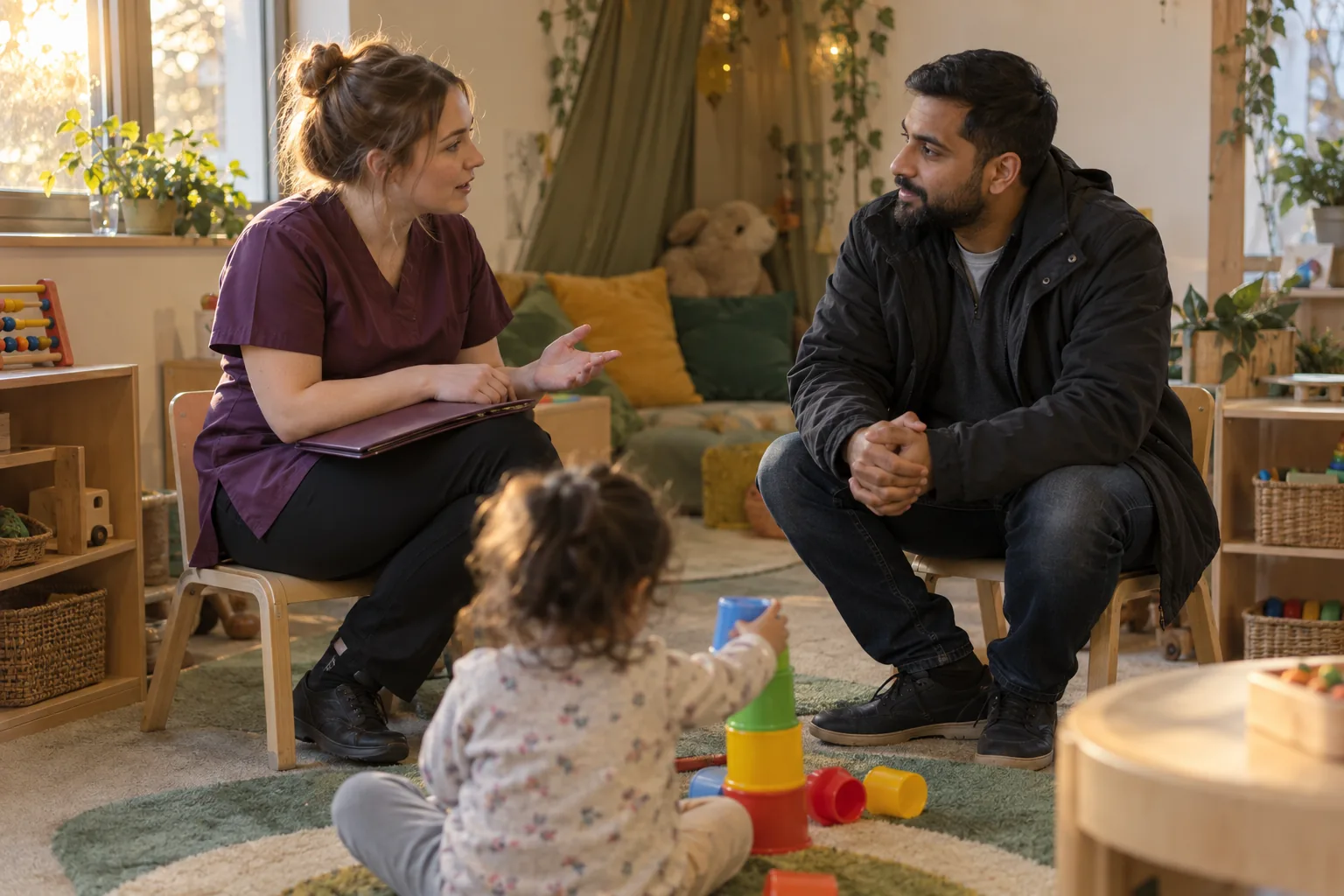
Raising a concern with a parent takes skill. The guidance advises preparing, finding a private place and a time that suits the parents, listening to them first, using simple and precise language with examples, not speculating about conditions or diagnoses, and ending with the child's strengths and clear next steps. A less experienced key person may need a senior colleague with them; the guidance's section on communicating with parents whose children have emerging or identified SEND is worth reading before the meeting.
Sharing has a rule. The framework says practitioners “should encourage parents and/or carers to share information from the progress check with other relevant professionals, including their health visitor”, but the setting needs the parents' consent to share it directly. The guidance defines what that consent means: “checking that the parent understands what information is being shared, why it is being shared, who it is being shared with, and what will happen to the information.” That consent rule governs routine sharing of the summary. It does not stop a setting sharing information without consent where a child is at risk of harm, under paragraph 3.9 of the framework and the Department for Education's statutory guidance Information sharing to safeguard children and young people; see information sharing between agencies.

The health visitor's review and the integrated review
Children in England have two checks between two and three: the EYFS progress check, done by the setting, and the health visitor's 2 to 2½ year health and development review. The Department of Health and Social Care's guidance on delivering the Healthy Child Programme: health visiting (February 2026) says the health review “is one of the 5 statutory universal reviews that should be offered to all families. It is typically expected to be delivered as an individual face-to-face contact by the named health visitor, usually between 24 and 30 months of age.” It adds that “completion of a screening tool alone – whether by post, online or without direct observation – does not constitute an acceptable review.”
The two checks are meant to connect. Paragraph 2.10 of the framework says that, where possible, the progress check and the Healthy Child Programme review “should inform each other and support integrated working”. The DHSC guidance says the reviews should, “where practical and necessary, include liaison between early years practitioners and health visitors, alongside parents”, but that “joint reviews may be appropriate in some cases, they are not always practical or necessary. However, where developmental concerns are identified, early years practitioners and health professionals should seek informed parental consent to share relevant information and work together to develop a co-ordinated support plan.” A targeted review at three and a half may follow for children with developmental delay or emerging concerns; it “is not part of the statutory universal offer”.
An integrated review at two is the joined-up version. The 2022 guidance says that “since 2015, the government has encouraged local authorities, health visiting services and early years providers to work together on an integrated education and health two-year-old review process”, and that “integrated reviews take a variety of formats. There is no one-size-fits-all solution”: a coordinated exchange of information in some areas, a joint meeting with parents and the child in others. It is encouraged, not mandatory, so find out what your local authority and health visiting service actually do. The guidance calls the child's Personal Child Health Record, the Red Book, “an effective tool to record and share information between all parties”.
The conversations around the check
The progress check is a document, but most of it happens in conversations. The key person messages a parent to find a time that suits both parents. The parent replies with a question about speech they did not want to ask at pick-up. The key person tells the SENCO in the staff group that she is worried about a child's hearing. The manager asks a parent whether they are happy for the summary to go straight to the health visitor, and the parent says yes by text.
Some of those messages matter later. A parent's agreement to share is the consent the framework requires, and if it exists only as a text on a key person's personal phone, the setting cannot show it was given. The first time a concern about a child's development was raised, and what was agreed, may be the start of a SEND support plan; when the key person leaves, that thread leaves with them.
ComplyChat is built for the work conversations a setting needs to keep. On paid plans, staff, and parents added by their mobile number, talk in channels the setting controls, everyone added is told the channel is on the record, and once the setting's Microsoft 365 tenant is connected, the lasting record files there. It is not an assessment tool or a learning journal, it does not write or store the progress check summary, and a parent's consent for anything significant should still be recorded where your policy says. The question for the next staff meeting: for the last progress check you shared with a health visitor, where is the record that the parents agreed?
Questions people ask
When should a 2 year check be done?
The EYFS progress check must be done when a child is aged between two and three (paragraph 2.6 of the group framework; 2.5 for childminders), at a point practitioners “must agree with parents and/or carers”. The Department for Education's guidance suggests delaying within that year if the child has only just started, has been ill or has attended irregularly.
Who completes the progress check at age two?
The Department for Education's guidance says the child's key person, “who usually knows the child best, should take the lead”, and that where a child attends more than one setting, “the setting where the child spends most of their time should complete the check”; if a child moves settings between two and three, paragraph 2.9 expects the setting where the child has spent most time to do it. A health visitor carries out a separate 2 to 2½ year review under the Healthy Child Programme.
Is the progress check at age two statutory?
Yes: section 2 of the EYFS statutory framework requires practitioners to review a child's progress between two and three and give parents “a short, written summary of their child's development in the prime areas” (paragraph 2.6). The Department for Education's Progress check at age two guidance (2022) and its example format are non-statutory.
Can I share the progress check with the health visitor?
Only with the parents' consent: “Providers must have the consent of parents and/or carers to share information directly with other relevant professionals” (paragraph 2.10). Practitioners should also encourage parents to share the check with their health visitor and any new setting themselves. Safeguarding concerns follow the separate information-sharing rules.
What are the key changes to the EYFS in 2026?
None of the 2026 changes affects the progress check: the frameworks in force from 1 September 2026 change safer sleep, screen use, banned dog breeds and safeguarding provisions, including allegations of “harm” rather than “serious harm” and DBS and barred list checks for supervised volunteers other than occasional helpers, while paragraphs 2.6 to 2.10 still set the same progress check requirements.
Official guidance and your next step
The requirement is in section 2 of the EYFS statutory frameworks. The Department for Education's non-statutory Progress check at age two guidance has the discussion prompts, an example format, an example letter to parents and a section on SEND. The health visitor's review is described in the Department of Health and Social Care's Healthy Child Programme health visiting guidance. Quotations are from those pages as published on 8 October 2026.
This guide covers the EYFS in England and is not legal or clinical advice. Wales, Scotland and Northern Ireland have their own early years frameworks and child health reviews, and your local authority may run its own integrated review process.
Then do one thing: list every child in your setting who turns three in the next three months, and check each has a date agreed with their parents for the progress check. Any child without one is the first conversation to have this week.
We build ComplyChat for the work conversations organisations need to keep, and in early years the arranging, the questions and the consent around a progress check often happen by message. Explore Free personal messaging, or compare the paid plans if your setting needs a lasting Microsoft 365 record.
Sources
Every document this guide quotes or links to, in the order it first cites them.