Monthly minutes nobody acts on prove very little; minutes that show what residents said, what the home did and what residents were told afterwards are some of the best evidence a home has. This guide covers the rule, running a meeting residents can take part in, a minutes template, the you-said-we-did loop and relatives' meetings.
The rule: seek and act on feedback, and involve people
Regulation 17(2)(e) of the Health and Social Care Act 2008 (Regulated Activities) Regulations 2014 requires every CQC-registered provider to have systems or processes that enable it to “seek and act on feedback from relevant persons and other persons on the services provided in the carrying on of the regulated activity, for the purposes of continually evaluating and improving such services”. The regulation does not mention residents' meetings, and no regulation or CQC guidance sets how often a home should hold one. The duty is the system for feedback; in residential care, regular meetings are one of the most common ways a home shows it has one.
Regulation 9, person-centred care, adds a second duty. Regulation 9(3)(f) requires “involving relevant persons in decisions relating to the way in which the regulated activity is carried on in so far as it relates to the service user's care or treatment”. Menus, mealtimes, activities, visiting arrangements and laundry are all decisions about how the home is run that affect each resident's care.
CQC's guidance on the two regulations is worded differently, and the difference is worth keeping. Its guidance on Regulation 17 says “should”: “Providers should actively encourage feedback about the quality of care and overall involvement with them. The feedback may be informal or formal, written or verbal. It may be from people using the service, those lawfully acting on their behalf, their carers and others such as staff or other relevant bodies.” It continues: “All feedback should be listened to, recorded and responded to as appropriate.” Its guidance on Regulation 9 says “must”: “Providers must actively seek the views of people who use their service and those lawfully acting on their behalf, about how care and treatment meets their needs. Providers must be able to demonstrate that they took action in response to any feedback.”
Who counts? Regulation 2 defines a “relevant person” as “the service user or, where the service user is under 16 and not competent to make a decision in relation to their care or treatment, a person lawfully acting on their behalf”. For an adult resident, the relevant person is the resident, so the residents' meeting is the residents' forum first. Relatives' views still count: Regulation 17(2)(e) covers feedback from “other persons” too, and CQC's guidance names carers expressly. A relative's view sits beside the resident's, not in place of it.
Running a meeting residents can take part in
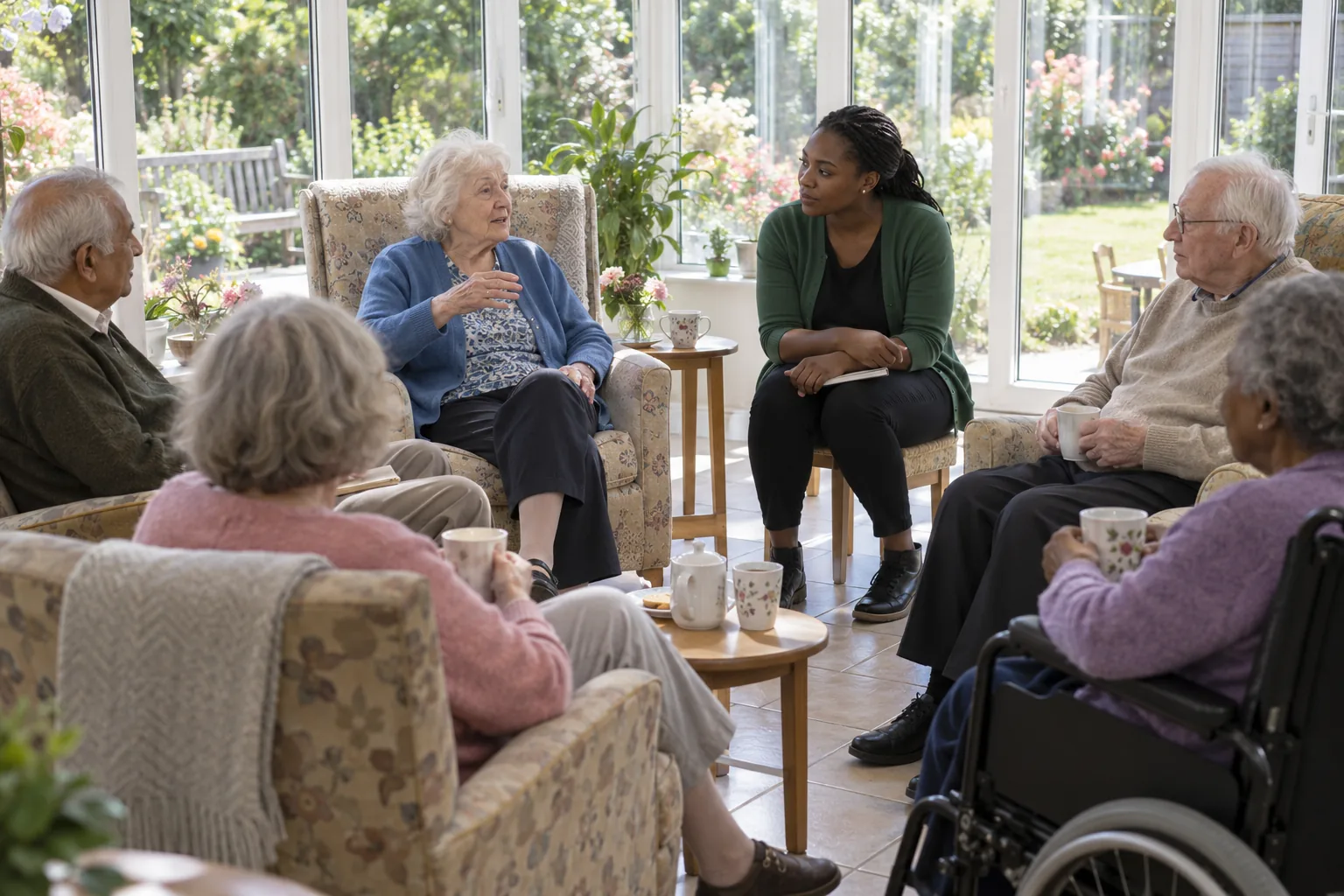
A residents' meeting is only evidence of involvement if residents could take part in it. NICE's guideline People's experience in adult social care services (NG86) suggests learning from people's experience through “forums within residential and day care services”, and recommends (1.6.7) seeking views “in such a way that the person feels safe to express their views, even if these are critical (for example, a care home resident may not want to give feedback directly to the manager)”. It also recommends (1.6.8) that independent advocacy is “available and offered” when it would help someone take part or the person prefers it.
The Accessible Information Standard applies too: “All organisations that provide publicly funded NHS care or adult social care must have regard to this standard.” For a meeting, that means the agenda and minutes in large print or pictures for residents who need them, a working hearing loop, a sign language interpreter where needed, and time for a resident to answer. In practice:
- Time and place. Mid-morning or mid-afternoon, not straight after lunch; a quiet lounge with the television off; under an hour, with tea.
- Who chairs. A resident if one is willing, supported by the activities coordinator. The registered manager attends part of it to answer questions; NICE's point about criticism is a reason for them not to run the whole meeting.
- Who takes notes. A staff member who is not leading the discussion, so residents' words are written down as they say them.
- People living with dementia. Smaller groups, one topic at a time, objects and photographs (the new menu, two fabric samples), and staff who know each person well.
- People who do not come. Ask the same questions one to one beforehand, and record how many residents gave views that way.
A simple care home residents' meeting agenda keeps the same order each time, so the minutes can be compared:
- Welcome, who is here and who is helping
- What happened about last time's points (the you-said-we-did report)
- Food and drink
- The activities programme, outings and visits
- The building, the garden, laundry and cleaning
- Staff and how care is given (as a group topic, not about one person)
- Anything else, and the date of the next meeting
Open questions work better than yes-or-no ones. Useful care home residents' meeting questions include: what has been the best thing about this month? Is there anything you would change about meals or mealtimes? What would you like to do that we do not do now? Is there anything that makes it harder to see your visitors? Do you know who to tell if something is wrong?
What the minutes record, and what they leave out
Residents' meeting minutes record feedback and the home's response, not a summary of a pleasant afternoon: what residents said, what the home replied and what it will do. General minute-taking technique is in our minute taking guide; a residents' meeting template needs a few things more.
Date, time and place, and who chaired and who took the notes
Attendance: the number of residents present, the number who gave views beforehand, and staff, advocates or relatives who attended
Support given: large print, pictures, hearing loop, an interpreter or an advocate
Last time's actions: each one with its status, and what residents were told
Each item: what residents said, in their own words where possible (“the soup is cold by the time it reaches the end table”)
The home's response: what the manager or staff said in reply
Actions: what will change, who owns it and by when
Taken forward separately: a note that an individual matter was passed to the right route, with no details
Next meeting: the date, and how the minutes will be shared
Leave out anything about one person's health, care, or a complaint about them or by them. Minutes are shared with residents and families and often pinned to a noticeboard. Information about a resident's health is special category data under Article 9 of the UK GDPR, and Article 5(1)(c) requires personal data to be “adequate, relevant and limited to what is necessary in relation to the purposes for which they are processed”. A meeting does not need a resident's diagnosis to decide that the lift needs fixing.
When an individual concern is raised in the meeting, take it out of the meeting and into the route that handles it: a complaint into the complaints log under Regulation 16 (our care home complaints procedure guide covers that), a possible safeguarding concern to the safeguarding lead the same day, and a change in someone's needs or preferences into their care plan. The minutes say only that the matter was taken forward. In the copy on the noticeboard, use first names or no names, and think twice before posting full minutes on a public website: a summary of themes and actions does the job without publishing who said what.
No regulation sets how long residents' meeting minutes must be kept. Keep them under the home's own retention schedule, alongside the action log they feed; our care records retention guide explains how a care provider sets one.
From minutes to change: you said, we did
The minutes become evidence when something follows from them. CQC's guidance on Regulation 17 says “Improvements should be made without delay once they are identified, and the provider should have systems in place to communicate how feedback has led to improvements.” Its quality statement Listening to and involving people expects that “People are kept informed about how their feedback was acted on. Where improvements are required as a result, people have the opportunity to be involved in shaping the solutions and measuring the impact.”
The common way to close that loop is a you-said-we-did report. NICE NG86 gives the idea as an example in a recommendation about publishing the results of research with people who use services (1.6.11): “making public how they have responded to people's feedback – for example, by using 'you said, we did' tables or case studies”. In a care home it works as a short table at the top of each meeting and on the noticeboard:
- You said: “we never get a choice of pudding”. We did: the cook now offers two puddings every day and asks the table, from 1 November.
- You said: “the garden door is locked when it's nice out”. We did: the door is open from ten to four in dry weather, with a member of staff on the patio.
- You said: “we would like to go to the seaside”. We are: pricing a minibus for June; we will bring two dates to the next meeting.
Include what the home could not do, and why. A request turned down without explanation reads as a request ignored; one turned down with a reason and an alternative shows the home listened.
Every action from the meeting belongs in the home's action plan, the single action log, with the same owner and date, so that the registered manager and the provider see feedback from residents alongside audit findings and complaints. Our care home quality assurance guide describes that log. Then report back at the next meeting, read the you-said-we-did table aloud, and put it on the noticeboard in large print with pictures where that helps.
Relatives' meetings, and how CQC looks at both
Many homes hold a relatives' meeting as well as a residents' one, often in the early evening or online. The same reasoning as NICE's point about criticism applies to families: some residents speak less freely with family present, and some relatives raise things they would not raise in front of a resident. A joint meeting suits a refurbishment plan; a residents-only forum keeps residents' own voice in the record.
Relatives' feedback counts under Regulation 17(2)(e) as feedback from “other persons”, and the home should record and respond to it in the same way. What a relative cannot do, without legal authority, is decide for an adult resident. Under the Mental Capacity Act 2005, an attorney under a registered lasting power of attorney, or a deputy appointed by the court, can make a decision for a person who lacks capacity to make it, within the scope of that authority. A relative's view on a change to the home is welcome feedback; a relative's agreement is not the resident's consent. Our mental capacity assessment records guide covers who decides when a resident cannot.
CQC assesses feedback mainly under the Listening to and involving people quality statement, under the responsive key question: “We make it easy for people to share feedback and ideas or raise complaints about their care, treatment and support. We involve them in decisions about their care and tell them what's changed as a result.” Its related regulations are Regulations 16 and 17, with Regulations 9 and 10 to “also consider”, and its “I statement” is “I am encouraged and enabled to feedback about my care in ways that work for me and I know how it was acted on.” What residents and relatives tell an inspector can then be set against the minutes and the action log.
In its initial response to the Better regulation, better care consultation (March 2026), CQC said that “Rather than using quality statements, our assessment frameworks will include a set of new supporting key lines of enquiry” and that “We will remove scoring from our assessment approach.” Its June 2026 update says pilots “will run between June and October 2026, with final evaluation in November 2026”. No date for the new framework had been published on 8 October 2026, so the current quality statements still apply; Regulations 9 and 17 are unchanged either way.
The feedback that never reaches the meeting
Most feedback about a care home does not arrive at a residents' meeting. A daughter texts the manager on a Sunday evening that her mother's tea arrives cold. A resident tells a night carer the lounge is freezing after nine, and the carer mentions it in the staff group chat. A son sends a photo of his father's cardigan in someone else's laundry basket to a carer's personal phone. CQC's guidance says feedback “may be informal or formal, written or verbal”, and that all of it “should be listened to, recorded and responded to as appropriate”. Each of those messages is feedback in that sense.
Held on a personal phone, it cannot be recorded or responded to in any way the home can show. When a family says it told the home months ago, the answer is in an app the provider cannot open, on the phone of a member of staff who may since have left.
ComplyChat gives those conversations a channel the home holds. A mobile number verified by SMS is the identity, so relatives, bank staff and agency workers without a work account can take part; everyone added to a channel is told it is on the record, and can leave at any time; and messages are recorded on the server as they are sent. On paid plans the lasting record files into the home's own Microsoft 365 once its tenant is connected, under its own retention rules. It does not run meetings, take minutes, hold the action log or replace the care record or complaints log. If a home's feedback already arrives in meetings, surveys and a visitors' book, it may not need it.
A question for the next managers' meeting: of everything relatives told this home by message in the last month, how much reached the action log, and could we show it?
Questions people ask
Do care homes have to hold residents' meetings?
No regulation requires a care home in England to hold a residents' meeting by name. Regulation 17(2)(e) of the 2014 Regulations requires systems to “seek and act on feedback”, and Regulation 9(3)(f) requires involving people in decisions about how the service is run as it affects their care; residents' meetings are one of the most common ways homes show both, alongside surveys and one-to-one conversations.
How often should residents' meetings be held in a care home?
No regulation or CQC guidance sets a frequency for residents' meetings. CQC's guidance on Regulation 17 asks providers to “actively encourage feedback” and to make improvements “without delay”, so the test is whether views are gathered often enough to act on and are recorded; many homes meet monthly or quarterly.
What should the minutes of a residents' meeting include?
Residents' meeting minutes should include the date, who attended and what support they had, progress on last time's actions, each item with what residents said in their own words, the home's response, and each action with an owner and a date. CQC's guidance asks that feedback is “listened to, recorded and responded to as appropriate”, so the response and the action matter more than the discussion.
What should not be included in meeting minutes?
Residents' meeting minutes should leave out anything about one person's health, care or a complaint about them: minutes are shared and often displayed, information about health is special category data under UK GDPR Article 9, and Article 5(1)(c) requires personal data to be “limited to what is necessary”. Individual concerns raised in the meeting go to the complaints or safeguarding route and the person's care record, with the minutes noting only that they were taken forward.
Should relatives attend residents' meetings?
Relatives can attend where residents want them to, and Regulation 17(2)(e) covers feedback from “other persons” as well as residents. NICE guideline NG86 recommends seeking views so that people feel safe to be critical, noting that “a care home resident may not want to give feedback directly to the manager”. Some residents also speak less freely with family present, which is why many homes hold a separate relatives' meeting as well as a residents-only one.
Official guidance and your next step
The primary sources are Regulation 17 and Regulation 9 on legislation.gov.uk; CQC's guidance on Regulation 17 and Regulation 9; the Listening to and involving people quality statement; NICE's NG86 recommendations; and NHS England's Accessible Information Standard. Quotations are from those pages as published on 8 October 2026.
This guide is a summary for care homes registered with CQC in England, not legal advice. In Wales, regulation 76 of the Regulated Services (Service Providers and Responsible Individuals) (Wales) Regulations 2017 requires the responsible individual to “put suitable arrangements in place for obtaining the views of” the people receiving care, their representatives, commissioners and staff, and Care Inspectorate Wales regulates; Scotland has the Care Inspectorate and Northern Ireland the RQIA.
Then do one thing: take the minutes of your last three residents' meetings and, for every point residents raised, find the action, the date it was done and the meeting at which residents were told. Any point without all three is the first line of your next you-said-we-did report.
We build ComplyChat for the work conversations organisations need to keep. Residents' meetings gather feedback on the record, and much of the rest arrives as messages to staff that a home never holds. Explore Free personal messaging, or compare the paid plans if your home needs a lasting Microsoft 365 record.
Sources
Every document this guide quotes or links to, in the order it first cites them.
- Health and Social Care Act 2008 (Regulated Activities) Regulations 2014 legislation.gov.uk
- Regulation 9 legislation.gov.uk
- Guidance on Regulation 17 cqc.org.uk
- Guidance on Regulation 9 cqc.org.uk
- Regulation 2 legislation.gov.uk
- People's experience in adult social care services (NG86) nice.org.uk
- Accessible Information Standard england.nhs.uk
- Article 9 of the UK GDPR legislation.gov.uk
- Article 5(1)(c) legislation.gov.uk
- Regulation 16 legislation.gov.uk
- Listening to and involving people cqc.org.uk
- Mental Capacity Act 2005 legislation.gov.uk
- Initial response to the Better regulation, better care consultation cqc.org.uk
- June 2026 update cqc.org.uk
- Regulation 76 of the Regulated Services (Service Providers and Responsible Individuals) (Wales) Regulations 2017 legislation.gov.uk