Those national anchors apply in England. A body map is a record of what was seen and said, not a medical examination or a diagnosis, and completing one never delays telling the safeguarding lead or getting medical help.
What a body map is, and the duties behind it
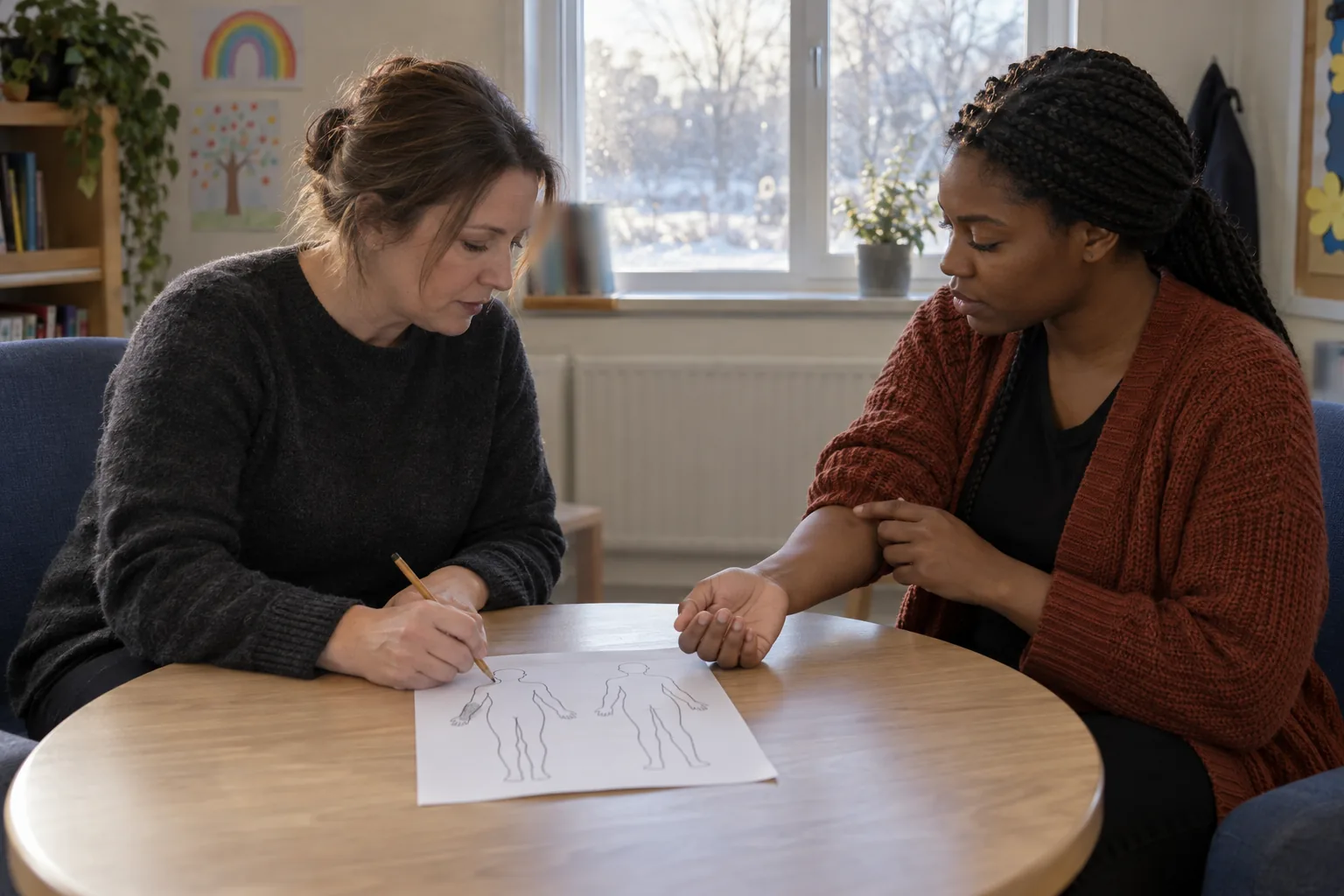
A body map is a recording form, not a legal requirement: no statute or national guidance in England defines one or requires its use. The forms are published by local safeguarding children partnerships and safeguarding adults boards, usually with a front and back body outline, sometimes with hands, feet and the head shown separately, and space for a written description. It is not the same as body mapping, a creative or therapeutic method in which people draw their own bodies; the safeguarding form records what an observer saw. The West Midlands procedures' child protection body map describes the purpose in one line: “The body map is simply a record of what can be seen and what has been said about the injury.” Use the form your own partnership publishes.
What is national is the duty to record a concern clearly. A body map is one way of meeting it:
- Schools and colleges. Paragraph 74 of Keeping children safe in education 2026 (KCSIE): “All concerns, discussions and decisions made, and the reasons for those decisions, should be recorded in writing.” Annex B adds: “Safeguarding records should be clear, factual, and distinguish between observed concerns, professional opinion, and historic information.”
- Early years. Paragraph 3.9 of the EYFS statutory framework for group and school-based providers: “If providers have concerns about children's safety or welfare, they must immediately notify their local authority children's social care team, in line with local reporting procedures, and, in emergencies, the police.” Paragraph 3.78 requires “a written record of accidents or injuries and first aid treatment”. The childminders' framework numbers these 3.10 and 3.77.
- Care homes and other regulated care. Regulation 17(2)(c), quoted in CQC's guidance on Regulation 17: Good governance, requires providers to “maintain securely an accurate, complete and contemporaneous record in respect of each service user”. NICE guideline NG189, Safeguarding adults in care homes, recommendation 1.5.1: if you consider abuse or neglect, “Seek medical attention for the resident at risk if needed. Record what you have found. Seek advice from a safeguarding lead (unless they are implicated in the alleged abuse or neglect). Check whether other indicators have previously been recorded.”
Those anchors are England's. Wales, Scotland and Northern Ireland have their own safeguarding procedures and inspectorates, and their local forms follow them.
When to use a body map
A body map belongs with any record where a visible mark is part of the concern:
- a member of staff notices a bruise, burn, cut or other mark that worries them, or one they cannot account for;
- a child or adult tells staff they have been hurt, and there is a mark to see;
- a child arrives at nursery or school with an injury and the parent or carer gives an explanation, which many settings record on an existing injury form with a body map attached;
- a care worker finds an unexplained mark on a resident during personal care.
Location and pattern matter, and a drawing shows them visually in a way a paragraph cannot. NICE's guideline CG89, Child maltreatment: when to suspect maltreatment in under 18s, written for healthcare professionals, says to suspect maltreatment if a child has “bruising in the shape of a hand, ligature, stick, teeth mark, grip or implement”, and gives “bruising in a child who is not independently mobile” as an example of bruising with an unsuitable explanation. Staff in a school, nursery or care home are not asked to make that judgement. They are asked to record precisely enough that the safeguarding lead, children's social care or a paediatrician can.
An existing injury form is a record, not an accusation. Its value is that a pattern across weeks becomes visible to the safeguarding lead, which a series of separate conversations at the door never shows. If the mark or the explanation causes concern, it stops being routine: it goes to the safeguarding lead, and in early years the EYFS requires the provider to notify children's social care immediately.
A body map never replaces medical attention. The West Midlands form says it “does not replace medical advice and so a proper diagnosis of the injury and correct treatment should be sought by a medical professional”. If a child or resident is in pain, or the injury looks serious, get help first and record afterwards.
Care homes also use body maps for skin integrity, pressure damage, wounds and where creams are applied. Those are clinical records. This guide is about the safeguarding use, though the same mark can appear on both, and the two should agree.
What to record on a body map
The form records two things: what was seen, and what was said. The rest of the concern record is in the safeguarding concern form guide. KCSIE's test for any safeguarding record is that it is “clear, factual” and distinguishes observation from opinion. The Leicester, Leicestershire and Rutland injury body map says “it is a record of what can be seen and what has been said”. A complete entry covers:
- Where. The mark drawn on the outline, front or back, left or right, and described in words: “outer side of the left upper arm, about halfway between shoulder and elbow”.
- What it looks like. Approximate size in centimetres, shape, colour or colours, whether the skin is broken, any swelling, and whether there are multiple marks.
- When and where it was seen. The date and time, the place, and the activity at the time.
- Who saw it. The name and role of the person completing the form, and anyone else present.
- What the child or adult said, in their own words, and what was said to them. NICE NG189 recommendation 1.6.6 asks care staff to “use simple and open questions, and ask in a non-leading way” and to “write down what they tell you, in their own words”.
- Any explanation given of how the injury was caused, by a parent, carer or anyone else, word for word, with who gave it and when.
- What happened next. Who was told, at what time, and any referral or medical attention.
- Signature, date and time of completion, which may be later than the time the mark was seen.
Describe, never interpret. “Red-purple mark about 3 cm by 1 cm” is an observation; “grab mark”, “non-accidental” or “cigarette burn” is a conclusion that staff are not qualified to reach and that a court or social worker may later read as fact. If a member of staff holds a professional opinion, the West Midlands form asks them to “make distinction between fact and opinion”: write it separately and label it as opinion.
Fictional example. Seen 9.10am, Tuesday, in the cloakroom while the child hung up his coat, by a teaching assistant, no one else present · Outline: four oval marks, each about 1 cm, in a row on the back of the right upper arm, blue-purple, skin not broken, no swelling · Child said, unprompted: “Dad squeezed my arm 'cause I wouldn't get in the car.” Asked “Can you tell me more?”; child said “It hurt” and went into class · No explanation from parent; child was dropped at the gate · DSL told in person 9.20am · Form completed 9.35am, signed and timed.
Local forms add their own instructions, such as completing the form in black ink; follow them. A body map is completed for each occasion, not updated: if the same mark is seen again days later, it goes on a new, dated form.
What staff should not do
The limits matter as much as the content: a well-meant examination or question can distress the person and damage a later enquiry.
- Do not examine or undress. This comes from local procedure, not a national rule. The Leicester, Leicestershire and Rutland form says: “If you see the child, make observations in the least obtrusive way; do not attempt a medical examination or get them to undress.” Record only what is visible on exposed skin in the ordinary course of the day, or what the child or adult chooses to show you. KCSIE says something similar in its section on female genital mutilation, that teachers “should not be examining pupils or students”, though that sentence is about FGM.
- Do not diagnose. The same form: “Workers should not attempt a thorough medical examination or diagnosis of the injury.” Leave the cause to medical professionals and social care.
- Do not lead or investigate. NICE NG189 recommendation 1.6.10 tells care home staff: “Do not investigate the situation yourself, because this could cause problems for police or other investigations and enquiries. Preserve any physical evidence as far as possible (for example, ask the resident to not wash or bathe) …” In schools and nurseries the safeguarding lead decides what happens next, not the person who noticed the mark.
- Do not delay the referral to finish the paperwork. The EYFS says “immediately”. Tell the safeguarding lead straight away; the body map can follow.
Photographs. No national statutory guidance for schools, early years or care homes says whether staff may photograph an injury, and neither body map form cited here mentions photographs. Many local safeguarding procedures advise staff to record on a body map and in words and to leave photographs to the police or medical professionals. KCSIE gives “taking photographs of children on their mobile phone, contrary to school policy” as an example of a low-level concern, which is reason enough never to use a personal phone. Follow your partnership's procedure and your setting's policy on images.
Where the body map goes, and who sees it
A body map is part of the concern record, never a loose sheet. Where it goes next depends on the setting:
- Schools and colleges. It joins the child's child protection file. KCSIE paragraph 74 says “It is good practice to keep concerns and referrals in a separate child protection file for each child”, and Annex B says the designated safeguarding lead should “ensure the file is only accessed by those who need to see it”. If the school refers to children's social care, the body map usually goes with the referral.
- Early years. A concern goes to children's social care immediately under paragraph 3.9 (3.10 for childminders). An allegation of harm by anyone living, working or looking after children at the premises must be notified to Ofsted, or the childminder agency, “as soon as is reasonably practicable, but in any event within 14 days” under paragraph 3.10 (3.11 for childminders), and failing to do so without reasonable excuse is an offence. A serious injury to a child in the provider's care must be notified to Ofsted, or the childminder agency, within 14 days under paragraph 3.79 (3.78 for childminders), which also requires providers to notify local child protection agencies and act on their advice. The guide to notifying Ofsted covers the forms.
- Care homes. It joins the resident's care record, kept securely under regulation 17. NICE NG189 recommendation 1.1.4 says care homes “should have systems in place for preserving evidence from reported safeguarding concerns, including care records, as these may be required in future, for example for local authority enquiries or police investigations.” Under regulation 18 of the Care Quality Commission (Registration) Regulations 2009, the registered person must notify CQC “without delay” of “any abuse or allegation of abuse in relation to a service user”.
No separate retention rule applies to body maps. They are kept for as long as the record they belong to: the child protection file in a school or nursery, or the care record in a care home, under the organisation's retention schedule. When a child changes school, the body map moves with the child protection file.
When the explanation arrives by text
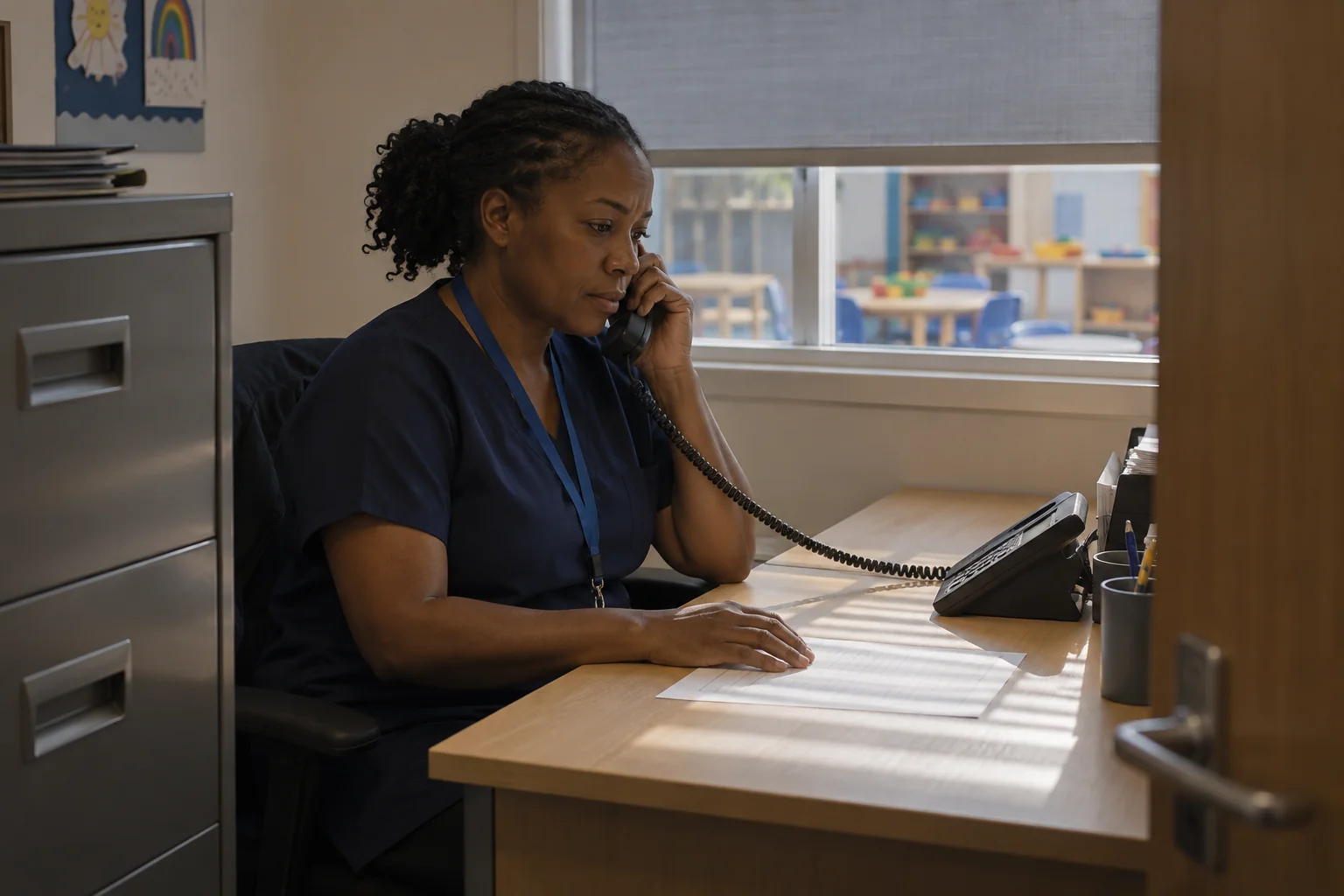
The body map is completed on paper or in the setting's safeguarding system. The words that matter most on it often arrive somewhere else. A parent texts their child's key worker before drop-off: he fell off his scooter at the weekend, that's the bruise on his arm. A night carer messages the manager at two in the morning about a mark she noticed on a resident's wrist while helping her to bed.
Each message is part of the same record. The parent's explanation is exactly what the body map asks for, word for word, with who gave it and when, and an explanation that changes between one telling and the next is something a safeguarding lead needs to see. When the message sits on a personal phone, it is transcribed from memory, if at all, and the original cannot be produced when children's social care, CQC or a court reads the file.
ComplyChat is designed to keep those conversations on the organisation's record. Staff, and where the setting chooses, parents and families, talk in a channel the organisation holds; everyone added is told it is on the record and can object or leave; and a mobile number verified by SMS is an identity, so a parent or a bank carer does not need an account on the organisation's systems. On paid plans the lasting record files into the organisation's own Microsoft 365 once its tenant is connected, under its own retention rules. ComplyChat is not a safeguarding case management system, it does not hold body maps or child protection files, and it is no substitute for the referral or the conversation with the safeguarding lead.
A question for the next safeguarding or leadership meeting: when a parent's explanation for an injury arrives by text, where does it end up, and could the safeguarding lead produce it a year from now?
Questions people ask
What is a body map?
In safeguarding, a body map is an outline drawing of the front and back of the body on which staff mark where they saw an injury or mark, attached to a written record of what was seen and said. No statute defines it; local safeguarding partnerships publish the forms, which settings in England use to meet the recording expectations in KCSIE, the EYFS and, for care, CQC regulation 17.
What should be recorded on a body map?
Where the mark is, its approximate size, shape and colour and whether the skin is broken, when and where it was seen and by whom, what the child or adult said in their own words, any explanation given and by whom, and what was done next, signed, dated and timed. KCSIE 2026 asks that safeguarding records are “clear, factual” and distinguish observed concerns from professional opinion.
Can staff take photographs of a child's injuries?
No national statutory guidance for schools, early years or care homes says whether staff may photograph an injury. Many local safeguarding procedures advise recording on a body map and in words and leaving photographs to the police or medical professionals, so follow your own partnership's procedure and your setting's policy on images, and never use a personal phone.
Should staff examine or undress a child to complete a body map?
No. None of the national guidance cited here sets a general rule on it; local procedure does. The Leicester, Leicestershire and Rutland injury body map, a social work form, says “make observations in the least obtrusive way; do not attempt a medical examination or get them to undress”. KCSIE's only comparable sentence, in its section on female genital mutilation, says teachers “should not be examining pupils or students”. In care homes, NICE NG189 tells staff not to investigate themselves and to preserve evidence.
Who can see a body map?
Only those who need to. KCSIE 2026 Annex B says the designated safeguarding lead should ensure the child protection file “is only accessed by those who need to see it”, and in care the record is kept securely under regulation 17; the body map is shared with children's social care, the local authority or the police when a referral is made.
Official guidance and your next step
The national sources are paragraph 74 and Annex B of Keeping children safe in education 2026; paragraphs 3.9, 3.10, 3.78 and 3.79 of the EYFS framework for group and school-based providers and 3.10, 3.11, 3.77 and 3.78 of the childminders' framework; NICE NG189 recommendations 1.1.4, 1.5.1 and 1.6.5 to 1.6.10; CQC's Regulation 17 guidance and regulation 18 of the Registration Regulations 2009; and, for clinical context, NICE CG89. The body map itself is your local safeguarding partnership's. Quotations are from those pages as published on 8 October 2026.
This guide summarises guidance that applies in England and is not legal or clinical advice. Your local safeguarding children partnership or safeguarding adults board sets the procedure and the form you should use.
Then do one thing: find the body map your setting actually uses, check it is your partnership's current form, and check that it has space for the words the child, adult or parent used.
We build ComplyChat for the work conversations organisations need to keep. A body map records what was seen; the explanation often arrives in a message to someone's phone. Explore Free personal messaging, or compare the paid plans if your organisation needs a lasting Microsoft 365 archive.
Sources
Every document this guide quotes or links to, in the order it first cites them.
- Child protection body map trixcms.trixonline.co.uk
- Keeping children safe in education 2026 gov.uk
- EYFS statutory framework for group and school-based providers assets.publishing.service.gov.uk
- Childminders' framework assets.publishing.service.gov.uk
- Regulation 17: Good governance cqc.org.uk
- NG189, Safeguarding adults in care homes nice.org.uk
- CG89, Child maltreatment: when to suspect maltreatment in under 18s nice.org.uk
- Leicester, Leicestershire and Rutland injury body map trixcms.trixonline.co.uk
- Regulation 18 of the Care Quality Commission (Registration) Regulations 2009 legislation.gov.uk