
The single-word judgements – ‘outstanding’, ‘good’, ‘requires improvement’, ‘inadequate’ – ended with inspections from 10 November 2025, and a report card replaced the old report. This guide sets out the documents in force, what is graded and how, what happens from the phone call to final feedback, what to have ready and what not to prepare, and what follows a grade, including for funding.
The framework and the documents behind it
Ofsted's education inspection framework, for use on inspections from 10 November 2025, “sets out how Ofsted inspects registered early years settings, maintained schools, academies, non-association independent schools and further education and skills provision in England”. It says: “We use a 5-point scale to grade different areas of a provider’s work. From November 2025, we no longer provide an overall effectiveness grade for any provider inspected under the framework. Safeguarding is evaluated on a ‘met’/‘not met’ scale for providers.”
The framework holds the principles; three early years documents hold the detail, all for use from 1 September 2026. The early years inspection toolkit (version 2.0, June 2026) “sets out the areas that will be evaluated and graded on inspections of registered early years and childcare provision under sections 49, 60 and 77(2)(b) of the Childcare Act 2006”, with the grading standards for each. The operating guide for inspectors says what inspectors do. The early years inspection information is written for providers and parents. Together they replaced the early years inspection handbook. Ofsted says the toolkit will be updated “as required, usually on an annual basis”, and that the renewed inspections place “a stronger emphasis on leadership as a driver of sustained improvement, and on inclusion”, looking at how well children achieve, belong and thrive.
Inspection follows the EYFS. The inspection information says: “Inspection is aligned with these principles and requirements. We do not have additional or separate rules.” The June 2026 toolkit also made explicit, in Ofsted's summary of changes, “that providers must meet the toolkit standards as well as the relevant early years foundation stage (EYFS) requirements”.
Who is inspected this way: every setting on the Early Years Register, including childminders, nurseries, pre-schools and schools that take children under two. Schools whose provision for children aged two and over is exempt from registration are inspected within their school inspection, under the school toolkit. Childminders registered with a childminder agency get the agency's quality assurance visits instead, and Ofsted inspects the agency. Providers registered only on the Childcare Register get compliance inspections, not graded ones: Ofsted's guidance on Childcare Register compliance inspections says “each year, we inspect 10% of all providers on the Childcare Register”, with an outcome letter published for 12 months instead of a report card.
What is graded: seven areas, five grades, and safeguarding met or not met
The framework says “the evaluation areas for registered early years providers we inspect are: safeguarding; inclusion; curriculum and teaching; achievement; behaviour, attitudes and establishing routines; children’s welfare and wellbeing; leadership and governance”. These are not the school areas: there is no attendance or personal development area for a nursery. For before- and after-school and holiday provision, which need not meet the EYFS learning and development requirements, “the evaluation areas for curriculum and teaching and for achievement do not apply”.
Safeguarding is ‘met’ or ‘not met’. Ofsted's safeguarding expectations “are those the DfE has set out in the EYFS, Keeping children safe in education and Working together to safeguard children”, and the toolkit's factors include “making sure all safeguarding decisions are accessible for scrutiny, and accepting challenge so that the right decisions are made”. The June 2026 toolkit made explicit that ‘not met’ includes settings “where the quality of care is such that children have been harmed or are at risk of harm”.
The other six areas are graded on the five-point scale:
- Exceptional: clear evidence of the standards that define exceptional practice, on top of every strong standard.
- Strong standard: all the expected and strong standards are met.
- Expected standard: “all the standards are met – this includes meeting the legal requirements and the expectations set out in statutory guidance”.
- Needs attention: the expected standard is not reached, there are breaches of the EYFS that do not have a significant impact on children, and no ‘urgent improvement’ indicator applies. Ofsted's guide to understanding Ofsted report cards and grades says it “is an indication that there is work to be done to reach the ‘expected standard’. It’s not a ‘fail’”.
- Urgent improvement: the area “needs urgent action to provide a suitable standard of education and/or care”, because breaches have a significant impact on children or there are concerns about the provider's suitability.
The grade is built upwards. The operating guide tells inspectors to ask first whether a setting reaches all the expected standards (“a secure fit”), then all the strong standards, then whether there is clear evidence of exceptional practice. “Some minor inconsistencies may lead to priorities for improvement but do not lower the grade.” Inspectors are “not expected to check that the setting meets every statutory requirement set out in the EYFS”, but a breach they find is weighed for its impact. A safeguarding ‘not met’ “does not automatically mean the setting will be provisionally graded ‘urgent improvement’ in other evaluation areas”. The new grades “can’t be compared to the old ones”.
How an inspection runs, from the call to final feedback
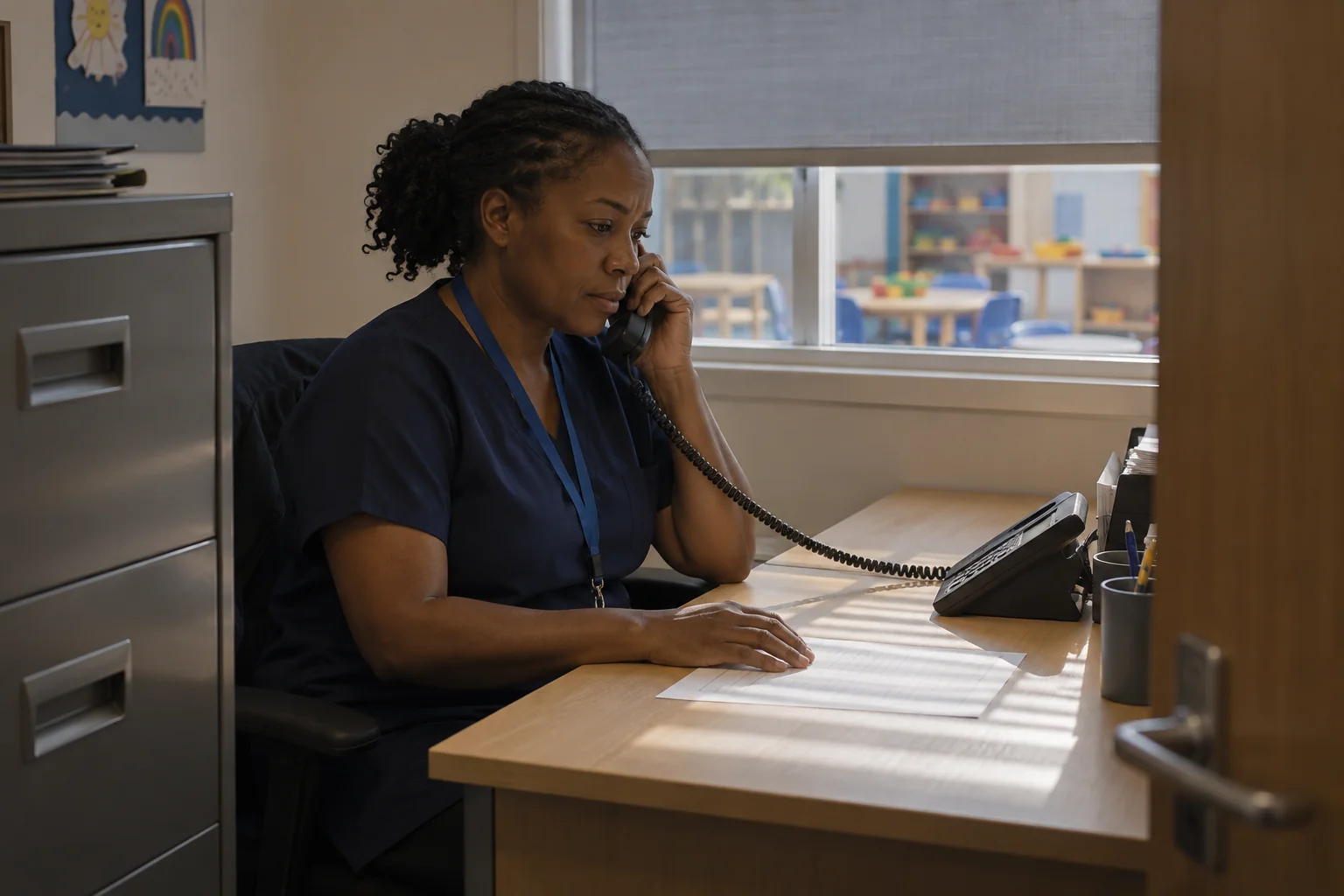
The notification call comes by telephone, “usually by 10am”, to the manager or, if they are unavailable, the most senior member of staff, unless Ofsted is inspecting without notice. For group provision the inspector “must call the setting on the working day before the inspection”. For childminders and group settings that do not operate regularly, such as holiday play schemes, the call comes “no more than 5 working days before the inspection to check which days they are operating and whether there are children on roll and present”. Ofsted says inspectors “will ask the setting not to record these calls or any further calls”. Once notified, the setting must tell parents, as paragraph 3.103 of the group EYFS statutory framework requires (3.102 for childminders), and let the inspector display a poster explaining the inspection.
A planning call of about 30 minutes follows the same day. The inspector asks about the setting's context and any changes since the last inspection, relevant safeguarding issues (the operating guide adds: “this includes any safeguarding concerns, or allegations made about adults”), leaders' priorities and how they have assessed their impact, the children who are disadvantaged, have SEND or are known to children's social care, and “where they believe they currently sit in terms of the 5-point grading scale for each evaluation area”. Children are chosen for case sampling. Larger group settings may name a nominee to liaise with the inspector; it is optional, and “there is no need for a nominee” for childminders or smaller settings.
On the day, inspections normally last “around 3 hours” for childminders, “around 4 hours” for group provision with restricted daily hours and “around 6 hours” for full-day group provision. There is normally one inspector; larger settings, or those where Ofsted has concerns, may get an inspection team. Any concerns Ofsted has received shape the inspection's focus. Early activities must include “reviewing DBS records as a priority”, recruitment and paediatric first aid, a meeting with the designated safeguarding lead, and checking that statutory guidance on safe sleeping, weaning and safer eating “is well understood and implemented effectively”. Then come shared observations, focused leadership discussions and case sampling, including each key person's knowledge of the children and the progress check at age two. Inspectors talk to parents, usually without staff present.
Reflective discussions run through the day, where the inspector shares emerging evidence, may agree an indicative grade with leaders, and asks about the wellbeing of staff and leaders. A grading discussion near the end sets provisional grades, and final feedback goes to those with overall accountability. Grades stay provisional until the final report card is sent, and leaders should not share them with parents before then.
What to have ready, and what Ofsted says not to prepare
Ofsted's inspection information lists two documents a setting must be able to show, online or on paper: “paediatric first-aid arrangements”, and “Disclosure and Barring Service (DBS) records and any other documents summarising the checks on, and the vetting and employment arrangements of, all staff working at the setting – this includes volunteers who engage in regulated activity with children”. Inspectors do not need to see DBS checks for childminders, providers of childcare on domestic premises, or “any known assistants and/or household members”, because Ofsted saw them at registration.
Inspectors “may need to see the policies required by the EYFS”, and other information such as referrals to the local authority designated officer and their resolution, details of children who are an open case to children's social care with a multi-agency plan, records of accidents, records of children refused a place, logs of discriminatory incidents, and complaints and their resolution. Ofsted adds that “it is likely that the inspector will cover the matters relating to them during discussions”. The nursery record-keeping guide sets out each record.
Just as plain is what not to prepare. Ofsted says: “We do not expect providers to have completed any formal self-evaluation using the toolkit. Leaders will not be at a disadvantage if they do not have a written self-evaluation.” It does not expect “written evidence to support each standard in each evaluation area”, does “not require photographic evidence of what children are doing and learning”, and does not expect “a presentation or any additional documentation about their setting or context”. The toolkit says “we do not need leaders to produce documents specifically for an Ofsted inspection”.
Inspectors have legal powers to see what exists. Ofsted's inspection information says section 77 of the Childcare Act 2006 gives inspectors a right “to inspect, and take copies of, any records kept by the person providing the childcare”, and adds “these powers allow inspectors to look at computers and other devices that may hold relevant information.”

After the inspection: report card, re-inspection, enforcement and funding
The report card is sent “within 18 working days of the end of the inspection” in most cases. The setting has 5 working days to comment on minor points of clarity or factual accuracy; where it does, the final report card normally follows within 30 working days of the end of the inspection, and Ofsted normally publishes it 5 working days after sending it. Under paragraph 3.103 of the EYFS framework, the setting must then give a copy to parents of children attending regularly. A formal complaint about the inspection is a separate route. Settings judged good or outstanding before November 2025 may use those Ofsted logos only “until their next graded inspection”.
Re-inspection follows the grades. Settings on the Early Years Register “will normally be inspected at least once within a 4-year window”, phased in from April 2026 with full implementation expected by March 2030, and new providers are normally first inspected within 18 months of registration. Information Ofsted receives between inspections is risk-assessed and can lead to a regulatory visit or an inspection without notice. A setting is usually inspected again within 4 years if every area is ‘expected standard’ or above, within 12 months if any area is ‘needs attention’, and within 6 months if any is ‘urgent improvement’ or safeguarding is ‘not met’.
Enforcement is not the school system of special measures. Where requirements are not met, Ofsted may set actions with a deadline, which appear on the report card; “when there is a significant failure to meet the safeguarding and welfare requirements, inspectors will normally serve a welfare requirements notice”, usually before the draft report card. Further steps are set out in Ofsted's early years and childcare enforcement policy.
Funding is where a grade bites. The Department for Education's statutory guidance on early education and childcare, valid from 1 April 2026, defines “specified grades” for Early Years Register providers inspected from 10 November 2025: for all entitlements, “‘urgent improvement’ in leadership and governance or safeguarding is ‘not met’”; for Early Learning for 2-year-olds, “‘needs attention’ or below in leadership and governance or safeguarding is ‘not met’”. When a provider receives one, the guidance tells local authorities to “withdraw funding from a provider (other than a local authority maintained school) as soon as is practicable”.
The decisions an inspector asks you to show
The renewed inspection is built on professional dialogue: what leaders are trying to achieve, how well they are doing it and how they know it is working. In practice, the inspector asks to see decisions. Why a concern about a child was or was not referred. What the setting did when a parent complained. How a key person learned about a change in a child's care. How staff raised a worry about a colleague. The toolkit's phrase is that “all safeguarding decisions are accessible for scrutiny”.
In most nurseries those decisions are made in conversations, and many of the conversations are messages: the manager and the DSL agreeing by text on a Sunday whether to call the front door service, the room leader telling the key person in the staff group that a parent has raised a concern, the owner of a small group asking a manager how a complaint was resolved. The decision may be well made and still not be accessible for scrutiny, because the reasoning sits on personal phones in a consumer app the setting does not hold, and leaves with the person who left.
ComplyChat is built for those work conversations. On paid plans, staff, and parents added by their mobile number, talk in channels the setting controls; everyone added is told the channel is on the record; and once the setting's Microsoft 365 tenant is connected, the lasting record files there. It is not an inspection pack, a self-evaluation or a safeguarding case management system, and nothing in Ofsted's documents requires a messaging product: a decision recorded properly in the right place is what counts. The question for the next leadership meeting: if the inspector asked tomorrow how you reached your last safeguarding decision, where would you find the conversation?
Questions people ask
What are the 5 new Ofsted grades?
The five Ofsted grades are exceptional, strong standard, expected standard, needs attention and urgent improvement, and in a nursery, pre-school or childminder setting each of six evaluation areas, from inclusion to leadership and governance, gets its own grade; there is no grade for the whole setting. Safeguarding is graded ‘met’ or ‘not met’, and there has been no overall effectiveness grade for inspections from 10 November 2025, under Ofsted's education inspection framework.
What are the new Ofsted inspection categories in 2026?
For registered early years settings, Ofsted grades seven evaluation areas: safeguarding; inclusion; curriculum and teaching; achievement; behaviour, attitudes and establishing routines; children's welfare and wellbeing; and leadership and governance. Early years settings are not placed in the school categories of concern; where EYFS requirements are not met, Ofsted may set actions or, for a significant failure in the safeguarding and welfare requirements, serve a welfare requirements notice.
What is the lowest Ofsted rating?
The lowest grade for an evaluation area is ‘urgent improvement’, given when the area “needs urgent action to provide a suitable standard of education and/or care”; safeguarding can be ‘not met’. An early years setting with any area graded ‘urgent improvement’ is usually inspected again within 6 months.
How often does Ofsted inspect nurseries and childminders?
Settings on the Early Years Register are normally inspected at least once in a 4-year window, introduced from April 2026 and fully in place by March 2030, and new providers normally within 18 months of registration. A setting is usually re-inspected within 12 months if any area is ‘needs attention’ and within 6 months if any is ‘urgent improvement’.
What is the 2 hour rule for Ofsted?
In early years there are two, and neither is an inspection rule. Care for a particular child for two hours or less a day is exempt from registration as a childminder under the Childcare (Exemptions from Registration) Order 2008; and a registered childminder may leave children in the sole care of an assistant “for up to two hours in a single day”, with parents' permission (paragraph 3.55 of the childminder EYFS framework).
What are the key changes to the EYFS in 2026?
The EYFS frameworks in force from 1 September 2026 add safer sleep requirements, a ban on childcare where banned dog breeds are present, a duty to have regard to screen use guidance, notification of allegations of ‘harm’ rather than ‘serious harm’, DBS and barred list checks for supervised volunteers other than occasional helpers, with no start before the check, a wider disclosure duty for staff and, for group providers on domestic premises, notice of changes to people aged 16 or over living or working there, according to the Department for Education's summary of changes to the EYFS framework. From September 2026 Ofsted inspectors check that statutory guidance on babies' sleeping, weaning and feeding is understood and implemented.
Official guidance and your next step
Read Ofsted's early years inspection information first, then the early years inspection toolkit for the standards and the operating guide for the day itself. The principles are in the education inspection framework, the requirements in the EYFS statutory frameworks, and the funding rules in the early education and childcare statutory guidance. Quotations are from those pages as published on 8 October 2026.
This guide covers Ofsted inspection of registered early years settings in England and is not legal advice. Wales, Scotland and Northern Ireland inspect childcare under their own arrangements.
Then do one thing: before the call comes, read the expected standard for leadership and governance in the toolkit with your deputy, and agree in one sentence each where you think you sit and why. That is the answer the planning call will ask for.
We build ComplyChat for the work conversations organisations need to keep, and in early years many of the decisions an inspector asks about were made in messages between the manager, the DSL, key persons and parents. Explore Free personal messaging, or compare the paid plans if your setting needs a lasting Microsoft 365 record.
Sources
Every document this guide quotes or links to, in the order it first cites them.
- Education inspection framework gov.uk
- Early years inspection toolkit assets.publishing.service.gov.uk
- Operating guide for inspectors gov.uk
- Early years inspection information gov.uk
- Summary of changes gov.uk
- Childcare Register compliance inspections gov.uk
- Understanding Ofsted report cards and grades gov.uk
- EYFS statutory framework gov.uk
- Section 77 of the Childcare Act 2006 legislation.gov.uk
- Early education and childcare gov.uk
- Summary of changes to the EYFS framework help-for-early-years-providers.education.gov.uk